
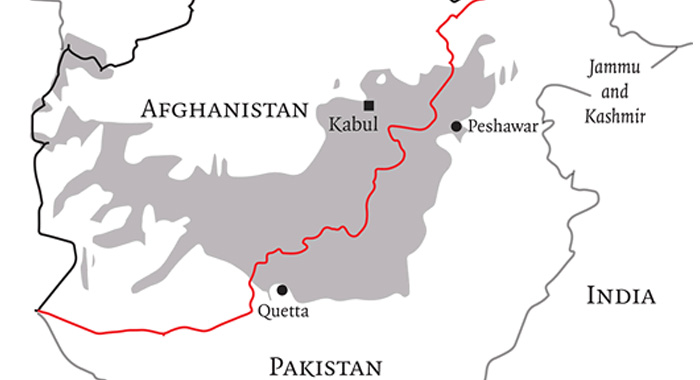
Recent rhetoric questioning the legitimacy of the Durand Line is not only detached from historical reality but represents a dangerous attempt to revive long-settled issues through misinformation, religious manipulation, and political theatrics. Such claims hold no legal, moral, or strategic weight and will not alter established facts on the ground.
The Durand Line was formally demarcated in 1893 through an agreement signed by Amir Abdur Rahman Khan, the internationally recognized and sovereign ruler of Afghanistan. This was not a temporary arrangement, nor was it imposed upon a powerless authority. It was a binding and permanent border agreement entered into by a legitimate Afghan state exercising full sovereignty. Any suggestion otherwise contradicts documented history.
This border arrangement did not rest on a single document alone. It was reaffirmed through subsequent treaties and agreements over the decades, including those concluded in 1905, the Treaty of Rawalpindi in 1919, and the Anglo-Afghan Treaty of 1921. These instruments collectively reinforce the continuity and permanence of the Durand Line as an international boundary.
For more than 130 years, Afghan governments across the political spectrum monarchies, republics, communist administrations, Islamist movements, and interim authorities have, in practice and in law, recognized the Durand Line. The occasional revival of claims against it has never stemmed from legal principle or popular mandate, but from irredentist fantasies fueled by internal crises and a lack of governance legitimacy.
When Pakistan emerged as a sovereign state in 1947, it inherited all internationally recognized borders of British India in accordance with the universally accepted principle of state succession. This inheritance has been upheld by the United Nations, respected by the global community, and enforced through Pakistan’s consistent exercise of sovereignty. No international body, court, or credible state has ever questioned Pakistan’s legal title to territory east of the Durand Line.
Invoking religion to challenge solemn treaties signed by Muslim rulers is both intellectually dishonest and theologically indefensible. Islam does not sanctify the violation of oaths, nor does it reward those who undermine agreements for political expediency. Divine authority cannot be claimed to erase borders established through lawful and binding accords.
Recent attempts to portray militant resurgence as divine or popular “victory” are equally misleading. Power obtained through waiting out geopolitical shifts and walking into a vacuum does not constitute a legitimate mandate. Opportunism cannot substitute for governance, and coercion cannot replace consent.
The Durand Line today is not merely a historical artifact; it is a living and enforced reality. It is reinforced by geography, by Pakistan’s effective control of its frontier, by the resolve of its people, and by the strength and professionalism of its armed forces. Pakistan’s strategic capabilities ensure that any threat to its territorial integrity is neither underestimated nor unanswered.
Empty threats, inflammatory rhetoric, or symbolic calls to violence from an unrecognized, economically distressed, and diplomatically isolated authority will not redraw borders or alter strategic realities. Any attempt to do so would result in consequences far beyond the capacity of such actors to absorb.
Pakistan remains committed to peaceful coexistence, regional stability, and adherence to international law. However, its sovereignty is inviolable. The Durand Line is settled, permanent, and non-negotiable etched not only into treaties and maps, but into the enduring realities of power, law, and history.



