
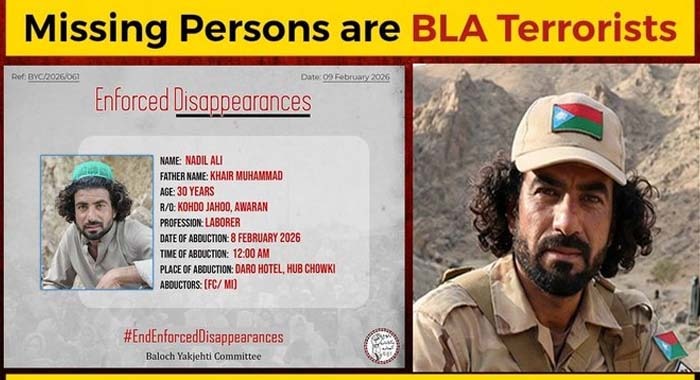
Recent claims circulating on social media and advocacy platforms regarding the alleged enforced disappearance of an individual identified as Nadeel Ali require urgent clarification in light of emerging evidence. The individual, portrayed by the Baloch Yakjehti Committee (BYC) as a “missing civilian” and a “laborer” allegedly abducted by state institutions on February 8, has been identified through multiple sources as an active commander affiliated with the banned militant organization Balochistan Liberation Army (BLA), specifically linked to its Majeed Brigade wing.
Available visual evidence reportedly shows the individual in militant attire, wearing insignia associated with the BLA, and present in mountainous terrain known to host militant training camps from which attacks against Pakistan have been planned and executed. These details contradict the narrative that he was an unarmed civilian forcibly disappeared from a public setting.
Security sources indicate that the case reflects a recurring pattern in which individuals with documented affiliations to militant networks are publicly presented as “missing persons” in order to generate sympathy, shape public perception, and advance a broader political narrative.
In a previous instance, an individual identified as Waleed, son of Abdul Majeed, was also presented as a “missing civilian.” Subsequent evidence revealed his association with the BLA as a suicide operative, including video material placing him within militant facilities. Observers note similarities between that case and the current claims regarding Nadeel Ali.
Analysts argue that such narratives aim to create the impression that ordinary civilians are being targeted, while obscuring alleged links to armed militant groups. This strategy, they contend, risks distorting public discourse and complicating legitimate human rights concerns by conflating cases of militancy with civilian disappearance allegations.
Authorities emphasize the distinction between counterterrorism operations targeting armed militants and genuine cases of enforced disappearance, underscoring the importance of responsible reporting and evidence-based advocacy.
Security officials reiterate that militant organizations operating in Balochistan continue to pose a serious threat to public safety, and efforts to combat terrorism remain focused on individuals directly involved in violent activities against the state.
The situation highlights the need for transparency, careful verification of claims, and a balanced approach in addressing security and human rights issues to prevent misinformation from undermining public trust.



