
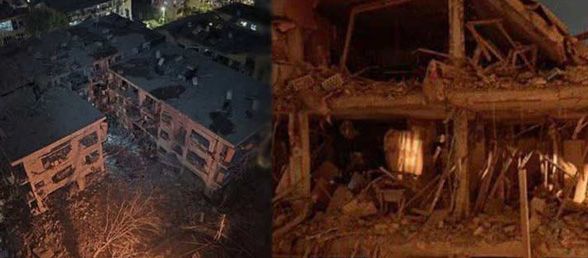
Following attacks on Iran’s nuclear facilities by the United States and Israel, Iran has launched a series of missile strikes targeting southern and central Israeli cities, including Arad, Dimona, and surrounding areas, using cluster warhead-equipped missiles. Iranian authorities stated that the strikes on Dimona were a direct response to Israeli attacks on the Natanz nuclear enrichment center.
Reports indicate that Dimona, one of Israel’s most secure cities and home to its nuclear facility, has experienced unprecedented damage. The city reportedly faced its fifth missile attack in 24 hours, with one three-story building completely destroyed and nearly 50 people injured. In Arad, Iranian missile strikes killed six individuals and injured over 100, while at least 20 buildings sustained significant damage.
Iran’s Islamic Revolutionary Guard Corps (IRGC) claimed that the strikes targeted military installations and security centers in multiple Israeli cities, including Eilat, Dimona, Beersheba, and Kiryat, and extended to bases in Kuwait’s Ali Al-Salem Air Base and two sites in the United Arab Emirates, resulting in over 200 casualties according to Iranian statements, though these figures have not been independently confirmed by Israeli authorities.
Simultaneously, Iranian media reported air raids on Tehran, Isfahan, and Kharg, with explosions and smoke observed across several districts. Precise targets and casualty details remain unverified, and security and emergency agencies are actively monitoring the situation.
The Israeli government has issued warnings of potential new missile strikes in southern regions, including Dimona, Beersheba, and areas near the Dead Sea. Reports indicate that the Dimona missile defense system may have been compromised, highlighting the increasing difficulty in intercepting large, sophisticated warhead-equipped missiles capable of causing widespread destruction over areas of up to 10 kilometers. Residents in these regions have once again been directed to move to designated safety shelters.
In Baghdad, Iraq, a powerful explosion struck a U.S. military base near the airport, causing widespread alarm across the city. Details regarding the method of attack and potential casualties remain unclear.
In response to the attacks, Israeli Prime Minister Benjamin Netanyahu announced the reinforcement of emergency and rescue forces in southern Israel, particularly in Arad, where extensive destruction was reported.
Saudi Arabia also reported intercepting and destroying six drones in the region following an initial successful interception, citing constant surveillance and rapid response by its defense systems to ensure regional security.
Additionally, northern Israel witnessed mortar attacks by Hezbollah, injuring two Israeli soldiers who were hospitalized for treatment.
The ongoing conflict has had a severe humanitarian impact. According to the Israeli Ministry of Health, at least 4,292 individuals have been injured since the beginning of hostilities, with casualties continuing to rise amid new missile strikes. Reports also indicate an explosion near a cargo vessel approximately 15 nautical miles north of Sharjah in the UAE, although all crew members were unharmed.
The International Atomic Energy Agency (IAEA) has confirmed awareness of missile incidents near Dimona but reported no damage to the nuclear research center or abnormal radiation readings.
The situation underscores the heightened volatility in the region, with cross-border attacks, civilian casualties, and the targeting of critical infrastructure raising concerns over wider regional escalation. Authorities urge vigilance, international monitoring, and coordinated emergency response to mitigate the growing humanitarian and security risks posed by these ongoing hostilities.



