
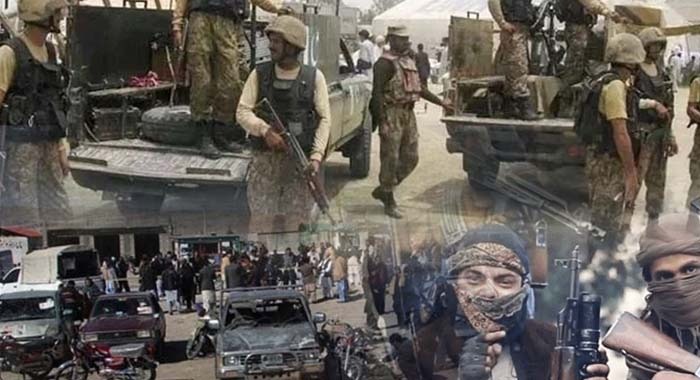
Militancy in the region continues to evolve beyond conventional battlefield confrontation, increasingly shaping its influence through ideological messaging, recruitment networks and psychological manipulation of vulnerable populations. Recent developments across Pakistan’s security landscape highlight how extremist groups combine operational violence with propaganda strategies to sustain their presence. From intelligence-led counterterrorism operations to the exploitation of young recruits, security challenges are no longer confined to physical attacks but extend into social and informational domains.
The security picture began with counterterrorism operations in Bannu and surrounding districts, where intelligence-driven raids resulted in the elimination of militants linked to extremist networks. The coordinated operations reflected Pakistan’s strategy of conducting pre-emptive strikes against militant hideouts rather than responding after attacks occur. Similar engagements across Khyber, South Waziristan and Dera Ismail Khan further demonstrated the multi-front nature of the country’s counterterrorism campaign.
Operations in Balochistan added another dimension to the security response. Security forces targeted militant factions associated with extremist groups, eliminating fifteen militants in two separate raids in Harnai and Basima districts. Weapons, explosives and ammunition were recovered, confirming that the dismantled cells were involved in organized violent activity. The operations underline the ongoing effort to disrupt militant infrastructure before it can be operationalized for attacks.
Beyond battlefield operations, the story of Zarar Wazir from North Waziristan illustrates the human dimension of militancy. The young man, reportedly a Hifz graduate, was allegedly recruited by associates of militant commanders and subjected to ideological persuasion and psychological pressure. Accounts suggest that militant handlers attempted to exploit religious narratives, promising spiritual reward while concealing the violent reality of suicide missions.
The case reflects a broader pattern of youth exploitation by militant networks operating in remote regions. Vulnerable individuals are often targeted through social influence, economic pressure or ideological conditioning. Investigators believe that recruitment chains are designed to protect senior militant leadership while placing operational risk on young recruits.
Meanwhile, counterterrorism efforts under the Azm-e-Istehkam campaign continue to target militant sanctuaries and cross-border threat channels. Reports regarding Tehreek-e-Taliban Pakistan and affiliated networks indicate that security forces are attempting to weaken both operational cells and propaganda ecosystems used for recruitment and messaging.
Information warfare has also emerged as a significant component of modern militancy. The circulation of images of attackers and glorification narratives through digital platforms demonstrates how extremist organizations attempt to shape perception. Such propaganda is aimed at both internal morale building and external recruitment.
At the regional level, strategic uncertainty remains a key factor. A recent intelligence assessment concerning Iran suggested that large-scale military strikes are unlikely to dismantle Iran’s political or military leadership. The assessment highlights the limitations of conventional military power in achieving political transformation. Institutional continuity mechanisms, succession protocols and centralized control structures contribute to state resilience even under external pressure.
Analysts note that modern conflict has moved beyond simple military confrontation. The interaction between militant networks, state security responses, and geopolitical competition creates a complex environment where violence, narrative influence and strategic calculation coexist.
The overarching challenge for security policymakers is therefore not only to neutralize militant operations but also to address recruitment pathways, propaganda dissemination and socioeconomic vulnerabilities that allow extremist ideologies to persist.



