
The developments reported over the past days paint a complex and troubling picture of security and governance challenges stretching from Afghanistan’s internal crisis to militant activity affecting Pakistan’s border regions and beyond. Taken together, the incidents, statements, and humanitarian warnings highlight a pattern in which militancy, governance failures, and regional tensions are becoming increasingly interconnected.
At the center of many of these concerns lies Afghanistan under the rule of the Taliban. Critics argue that the group’s inability or unwillingness to curb militant networks has turned the country into a sanctuary for various armed factions. Afghan opposition leader Ahmad Massoud, head of the National Resistance Front, recently warned that more than twenty militant organizations are currently operating inside Afghanistan, including the Tehreek-e-Taliban Pakistan. His remarks echoed a growing regional concern that militant groups continue to exploit Afghan territory to organize, recruit, and plan attacks.
Massoud’s criticism was particularly pointed. He argued that Afghanistan has once again become “a haven for militant groups,” while ordinary citizens face worsening economic hardship and repression. At the same time, he rejected foreign military interventions as a solution, arguing that sustainable stability requires listening to the Afghan population rather than empowering the Taliban leadership.
The issue of militant activity spilling into neighboring areas remains a central concern. Recent security incidents in Pakistan’s Khyber Pakhtunkhwa, including a rocket shell landing in Bannu, highlight the volatility of the region. Although the attack caused no casualties, it reinforced fears that militant networks retain the ability to strike symbolic or security-related targets even in settled districts.
These incidents coincide with broader security operations aimed at dismantling militant infrastructure and preventing cross-border attacks. Pakistani officials argue that militant sanctuaries in Afghanistan continue to pose a direct threat to the country’s security, a claim frequently disputed by the interim Taliban administration. The resulting tensions have periodically escalated into clashes and air operations, illustrating the fragile and often confrontational nature of the current regional security environment.
Beyond the battlefield, the humanitarian dimension of Afghanistan’s crisis continues to deepen. The United Nations Children’s Fund has warned that roughly 1.3 million Afghan children suffering from severe acute malnutrition will require treatment this year alone, while millions more face varying levels of food insecurity. The World Food Program has also cautioned that cuts in foreign assistance and ongoing instability could push an additional 200,000 children into acute malnutrition.
These figures illustrate how governance failures and prolonged instability can translate into profound human suffering. When economic collapse, restrictions on social participation, and persistent conflict combine, the consequences often fall most heavily on vulnerable populations, particularly children.
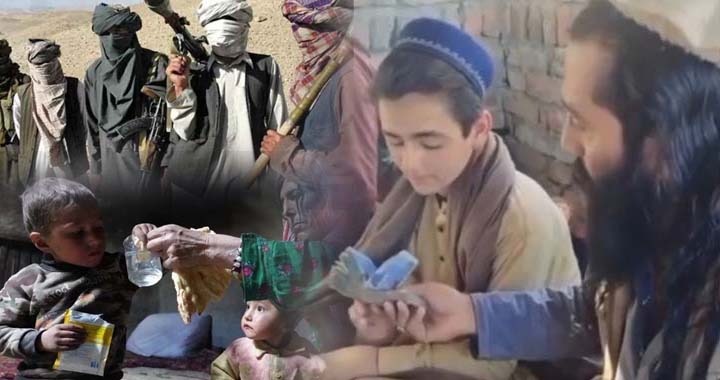
Another troubling dimension highlighted by recent reporting is the exploitation of youth by militant groups. A recently circulated video allegedly showing a militant handing cash to a young boy has sparked renewed debate about recruitment tactics used by extremist networks. Security analysts say such methods often involve a mixture of financial inducements, ideological indoctrination, and psychological pressure. In many cases, impoverished or vulnerable children become the easiest targets for recruiters seeking to sustain militant operations.
The pattern is not new, but it remains deeply alarming. Over the years, numerous investigations into terrorist attacks in the region have revealed that many perpetrators were initially drawn into extremist networks as teenagers or even younger.
Meanwhile, security concerns are not limited to land-based threats. Maritime security has also gained prominence, prompting the Pakistan Navy to launch Operation Muhafiz-ul-Bahr to safeguard commercial shipping routes and energy supply lines. With nearly ninety percent of Pakistan’s trade conducted through sea routes, ensuring the security of maritime corridors has become a critical national priority.
Taken together, these developments reveal a region confronting overlapping crises. Militancy, governance challenges, economic hardship, and humanitarian emergencies are not isolated problems but interconnected elements of a broader instability.
Unless these issues are addressed through coordinated security measures, responsible governance, and sustained humanitarian engagement, analysts warn that the cycle of instability may continue to shape the region’s future for years to come.



