
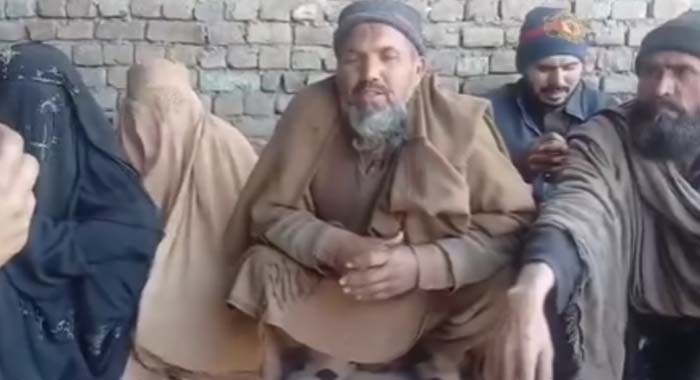
In a rare and courageous stand against extremism, residents of Tap Takhti Khel, Sarai Naurang, Lakki Marwat, have publicly disowned their own sons for joining militant outfits, rejecting the ideology and violence of proscribed groups.
Local residents Nematullah and Naik Salam declared that they have no ties or sympathy with their sons, Rehmat Dil and Muhammad Rehman, who recently joined a banned militant organization. The families also informed the local peace committees of their disassociation and reiterated that they will bear no responsibility for any illegal activities carried out by their sons.
“This decision was painful but necessary,” said Nematullah. “Our loyalty is with the state and the law. We have no connection with terrorism in any form, and our sons are no longer part of our family in terms of their actions.”
Recently, Muhammad Israr, a resident of Gambati, Bannu, also publicly disassociated from his son after learning of his involvement with the banned TTP. Israr said neither he nor his family had any connection with extremist or anti-state activities and emphasized that his loyalty lies with the state of Pakistan. He further stated that if his son ever returned, he would hand him over to law enforcement authorities immediately.
Similar incidents have been reported across the province. Usman Ghani, a resident of Painda Khel Domail, Karak, now living in Islamabad, disowned his son Rasool Ghani, stating that maintaining ties with someone engaged in terrorism had become morally and religiously unacceptable. He said he severed all relations and relocated his family to Islamabad for safety.
In another widely circulated case, a father from Kot Isa Khan, Dera Ismail Khan, publicly urged authorities to arrest or eliminate his son, identified as Siddique, affiliated with Fitna‑al-Khawarij (TTP). “I have no ties with him in life or death,” the father said in a video message that went viral on social media.
Security analysts say these public disownments reflect a broader shift in public sentiment across KP, mirroring similar rejection already seen in Balochistan and other parts of the country. They note that the tribal population along the Pak-Afghan border, which has suffered the most from militant violence, is now openly severing family and social ties with extremists.
“This level of rejection is unprecedented,” a senior security official said. “When families, tribes, and communities deny shelter, legitimacy, and sympathy, militant networks lose their most critical support base.”
Despite this unified societal front, analysts warn that tangible security gains remain limited, placing the spotlight on the Khyber Pakhtunkhwa provincial government, which critics accuse of failing to translate public resolve into effective governance and counter-terrorism outcomes.
Concerns have also been raised over the interim Afghan Taliban regime, which has yet to fulfill commitments made under the Doha Agreement and other international assurances regarding the prevention of cross-border terrorism.
Observers warn that while the people of KP have decisively rejected terrorism, continued governance failures and lack of cross-border enforcement risk undermining this momentum.
“The moral front is united,” an analyst said. “But without political will, administrative action, and regional compliance, public sacrifice alone cannot defeat terrorism.”
With the moral resolve of the citizens evident, analysts stress that it is now up to authorities to ensure that this societal rejection is complemented by strong governance, intelligence-based operations, and cross-border enforcement to fully dismantle extremist networks in the region.



