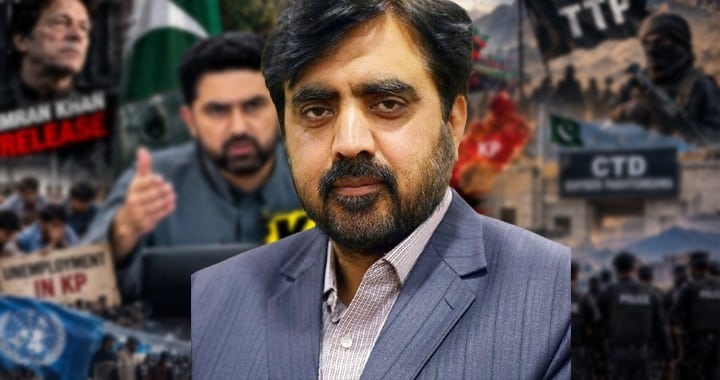
Khyber Pakhtunkhwa has the capacity to fight terrorism, and its police, Counter Terrorism Department (CTD), military and other law enforcement agencies have repeatedly demonstrated extraordinary courage in the face of deadly threats. Our personnel have stood their ground even when suicide bombers have confronted them, making sacrifices that deserve recognition and unwavering support. The problem is not simply whether we have the resources or the people to fight terrorism. The real question is whether the political leadership is standing firmly behind those who are fighting on the front lines.
Today, the police and CTD personnel operating against terrorists are themselves facing a sense of insecurity. They know the enemy they have to confront, but they are uncertain about the support they will receive from their own political leadership. They are fighting for the state and its people, yet they do not know what decisions will be made behind their backs or whether their efforts will be acknowledged and supported. This uncertainty is damaging morale at a time when clarity and confidence are essential.
When personnel put their lives at risk, they need to know that the government stands behind them. They need political ownership of their mission, recognition of their sacrifices and assurance that they will not be abandoned when they move against terrorist networks. Our police and security personnel have repeatedly proved that courage is not in short supply in this province. What is missing is consistent political support for their efforts.
The priorities of the ruling class are increasingly difficult to understand. Sit with a hundred or a thousand representatives of the political establishment and examine their priorities, and politics appears to come first. Public service and governance are pushed down the list, while small gestures are occasionally presented as evidence of performance.
Consider the chief minister. He arrives in Peshawar, inaugurates a bridge and then leaves to lead a long march. How long does he remain in the provincial capital to address its problems? Perhaps an hour, before departing for another extended period of political activity. The issue is not whether a chief minister can engage in politics. Every political leader has that right. The question is whether the person holding the province’s highest executive office is giving governance the attention it demands.
We still cannot clearly define Sohail Afridi’s role. Is he primarily a political campaigner, the chief executive responsible for governing Khyber Pakhtunkhwa, or a tribal figure expected to address the exceptional difficulties facing his community in Khyber district? These responsibilities are not necessarily incompatible, but they cannot be fulfilled if one role continually overshadows the others.
Khyber district has serious security and humanitarian challenges and remains under international attention. Its people need their chief minister to engage with their problems, hear their grievances and provide a clear account of what the provincial government is doing for them. A public office cannot be reduced to a title that is invoked during political campaigns while the responsibilities attached to it remain unattended.
The consequences of this confusion extend beyond the corridors of power. People are politically motivated, but they are deeply anxious about their future. They do not know what the ongoing confrontation between the federal and provincial governments will mean for their security, livelihoods or children. They are watching political leaders argue while the practical problems of everyday life continue to grow.
The economic pressures facing households are particularly worrying. A survey concerning Peshawar reportedly found that some families were gradually moving their children from expensive schools to less costly alternatives because they could no longer afford the fees. There have also been claims that as many as 89 percent of people in the province are living on borrowed money. Such figures require careful examination, but they point towards a wider concern that cannot be dismissed: families are struggling to meet their expenses.
Where is the provincial government’s comprehensive response to this pressure? Where are the practical measures to make essential food items more affordable, provide relief to low-income households and improve access to education? Other provinces have introduced various relief measures and development initiatives. Khyber Pakhtunkhwa’s people deserve the same seriousness of purpose.
The province has spent years hearing declarations about an educational emergency, yet the condition of schools and educational outcomes must be judged by results, not slogans. The promise of change was made more than a decade ago, but the honeymoon period of political expectations seems never to have ended. People cannot be asked to remain patient indefinitely while their basic needs go unmet.
Another troubling change is the growing distance between elected representatives and their constituents. Traditionally, politicians in Khyber Pakhtunkhwa maintained close relationships with voters through their hujras and party offices. People could approach them, discuss their problems and expect at least a hearing. Representatives were expected to remain accessible because their political standing depended on their relationships with the people.
That connection appears to have weakened. Many constituents feel that the doors of their representatives have closed and that their elected leaders assume the party’s popularity will continue to secure votes regardless of their individual performance. Political loyalty may remain strong, but loyalty should not be confused with a permanent licence to ignore public grievances.
The situation becomes even more dangerous when political denial enters the debate over terrorism. The first requirement for treating a problem is acknowledging that it exists. If a patient refuses to accept that he is ill, he will not seek treatment. The disease will continue to progress while those responsible insist that nothing is wrong.
Khyber Pakhtunkhwa’s terrorism problem cannot be addressed through denial or the assumption that political negotiations alone will resolve every security challenge. The Taliban have their own demands. They want space in which they can operate, move around armed and avoid accountability for their past actions. The state cannot allow such demands to replace its authority or undermine the safety of ordinary citizens.
The PTI’s approach to the Taliban during Imran Khan’s government remains an important part of this debate. Khan described them as his own people and advocated engagement with them. His government also pursued a policy of negotiations and the return of displaced members of the group. In my assessment, that approach failed to account adequately for the security risks of allowing people associated with an armed terrorist network to return without effective safeguards.
I have referred to approximately 8,500 people entering Pakistan during that period. The circumstances, identities and security implications of these returns deserve serious scrutiny. The essential question is whether the process was accompanied by sufficient verification, monitoring and arrangements to prevent the re-establishment of terrorist networks.
Once members of such networks are dispersed among relatives, communities and different locations, identifying and apprehending them becomes more complicated. Their presence can create a difficult situation for security forces, particularly when operations are followed by political accusations that civilian populations are being targeted. These concerns must be investigated carefully, and civilians must be protected. But the presence of families and other non-combatants cannot become a blanket justification for shielding terrorists from accountability.
Terrorists themselves bear responsibility for choosing to operate from populated areas, conceal their activities among civilians and expose innocent people to danger. When an armed individual uses family members or other civilians as human shields, the responsibility for that conduct rests with the person placing them at risk. Security operations must still distinguish between terrorists and civilians, and every effort must be made to minimize harm to innocent people. Protecting civilians and pursuing those responsible for terrorism are not mutually exclusive obligations.
We must also remember the enormous human cost of this conflict. Pakistan has lost countless civilians, police personnel, soldiers and officers from other law enforcement agencies. I have referred to the toll of nearly 100,000 lives lost in the wider conflict, a figure that should be treated as an estimate requiring clear definition rather than a settled count. Whatever the precise total, the sacrifices of those who have died and the suffering of their families cannot be ignored for political convenience.
The people of Khyber Pakhtunkhwa are not asking for much when they demand security, honest governance and a government that listens to them. They want to know that their representatives remember the promises made to them and understand the difficulties they face. This is particularly important for residents of Bannu, Dera Ismail Khan, Tank and the former tribal districts, where insecurity and displacement have placed enormous pressure on communities.
Displaced families need more than occasional visits and sympathetic statements. Leaving one’s home is not a simple change of address. It disrupts a family’s privacy, routine, education, livelihood and sense of belonging. Temporary accommodation, even when adequate by some standards, cannot replace the comfort and dignity of one’s own home. Families want clear information about when they can return, what assistance they will receive and what security arrangements will be in place.
People in the affected areas have complained that political representatives made promises about their return, financial assistance and rehabilitation but have not remained sufficiently accessible to answer their questions. When residents ask their representatives to speak for them, they should not be told that their concerns will be addressed after a long march or once a political dispute has been resolved.
The government must explain what has been done with the funds allocated to the province, including money intended to support security and development in the former tribal districts. If substantial resources have been provided, citizens have every right to demand transparent accounts of their use. How much was spent on roads, schools, colleges, police stations, rehabilitation and public services? What remains incomplete, and why? These are legitimate questions that require documentary answers rather than political counterattacks.
The long march may serve a political purpose for PTI, but its consequences for the party and the province will ultimately depend on what people believe it has achieved. A political movement cannot indefinitely rely on slogans while residents of conflict-affected areas wait for security, compensation and rehabilitation. If the government fails to perform the responsibilities entrusted to it, other institutions will inevitably be pressed to fill the resulting vacuum.
The federal government, the provincial government, the military, police and other institutions all have responsibilities towards the people. Their efforts should be coordinated rather than undermined by political point-scoring. Security forces need the confidence that the civilian leadership supports their lawful operations, while the provincial government must have a meaningful role in protecting its citizens and addressing the conditions that allow terrorism to persist.
Ultimately, Khyber Pakhtunkhwa needs leadership that recognizes the scale of the crisis and acts accordingly. Terrorism cannot be defeated by security operations alone if political leaders refuse to acknowledge the problem, and governance cannot succeed if elected representatives spend more time confronting one another than addressing the needs of their constituents.
Our police officers, CTD personnel and soldiers have demonstrated that they are prepared to confront the enemy. They must not be left uncertain about the support waiting behind them. The displaced must not be made to wait indefinitely for answers, and the public must not be expected to accept slogans in place of results.
The people of this province have given their representatives repeated opportunities to deliver. They now deserve a government that puts their security, dignity and future ahead of political expediency. The real test of leadership is not how loudly a leader can mobilize supporters, but whether the people living amid terrorism and hardship can see that someone is standing up for them.