
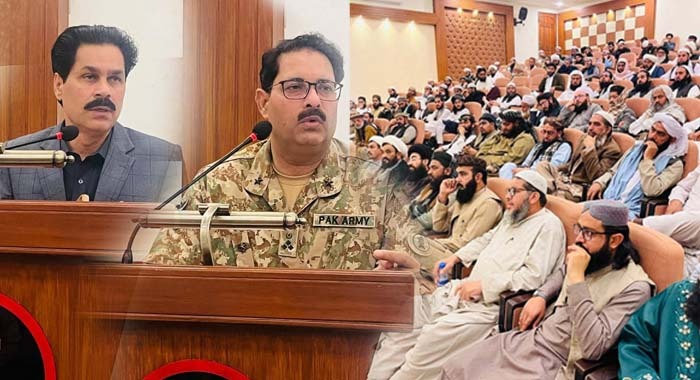
An important and comprehensive consultative meeting was held in Kohat under the auspices of the Pakistan Army, bringing together senior civil and military officials alongside prominent religious scholars from various schools of thought. The session focused on the prevailing national situation, strengthening trust between the public and state institutions, maintaining law and order, and promoting social cohesion across society.
The meeting was attended by the District Police Officer (DPO) Kohat, Brigadier Khurram Sabeel, Deputy Commissioner Muhammad Nawaz, and respected religious scholars representing diverse religious perspectives. The primary objective of the dialogue was to reinforce mutual trust between citizens and state institutions while formulating a joint strategy to address the intellectual and moral challenges confronting the younger generation.
Addressing the gathering, the DPO Kohat emphasized that certain disruptive elements are actively attempting to mislead youth and exploit them against the state and its institutions. He noted that these actors are pushing young minds toward ideological confusion and intolerance. Highlighting Pakistan’s identity as an Islamic ideological state founded in the name of Islam, he stressed that citizens must not allow themselves to become instruments of external agendas. Instead, he urged collective unity to ensure national stability, security, and development.
Religious scholars, in their remarks, underscored their responsibility as community leaders to stand alongside the state and government in promoting peace, tolerance, and brotherhood. They emphasized that Islam calls for unity, discipline, and respect for lawful authority. The scholars also raised concerns about the negative misuse of social media, noting that it often fuels distrust and pessimism within society, particularly among the youth. They called for responsible communication and the promotion of positive thinking to counter harmful narratives.
Brigadier Khurram Sabeel, while addressing the participants, highlighted the importance of ethics, patience, and constructive dialogue in resolving differences. He stated that disagreements should not be allowed to evolve into hostility and that reconciliation and reform must be prioritized over division. He acknowledged the pivotal role of religious scholars in guiding communities and serving as a bridge between the public and state institutions, ensuring clarity and cohesion during challenging times.
The Deputy Commissioner reiterated that sustainable peace and societal stability require close cooperation among citizens, religious leadership, and state institutions. He emphasized that collective effort and shared responsibility are essential for national progress and for addressing the challenges facing society.
At the conclusion of the meeting, participants reaffirmed their commitment to promoting positive values, patriotism, and national unity through sermons, public engagements, and community outreach. State institutions pledged to continue working collaboratively with religious leaders and the public to strengthen law and order, enhance social harmony, and foster an environment of mutual trust and cooperation.
The consultative session reflected a shared resolve to safeguard national cohesion and ensure that Pakistan remains united, peaceful, and resilient in the face of evolving challenges.



