
(Shamim Shahid)
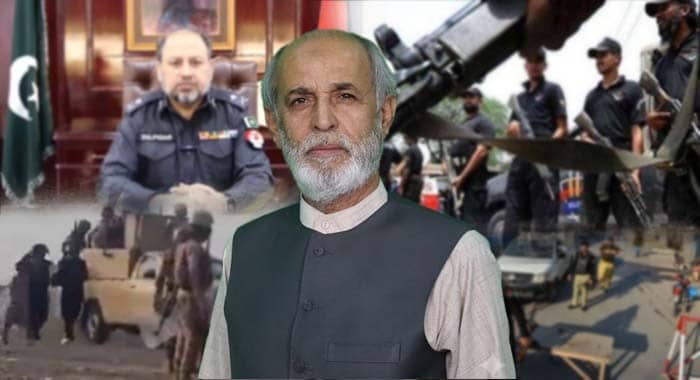
The evolving security landscape in the region straddling the Durand Line has once again come under intense scrutiny. Two parallel but interconnected developments demand serious reflection: the announcement by the police authorities in Khyber Pakhtunkhwa to establish a new cabinet-approved operational unit for counterterrorism purposes, and the continuing claims and counterclaims surrounding the security situation in Afghanistan, particularly in the backdrop of resistance activity by the National Resistance Front and the assertions made by the ruling Taliban.
These developments are not isolated events. They are, in fact, reflections of a deeper regional security crisis that has persisted for over two decades, marked by policy inconsistencies, institutional fragmentation, and the absence of a unified counterterrorism strategy.
The announcement of a new special operational unit by the police in Khyber Pakhtunkhwa has reignited the longstanding debate over how terrorism should be countered in the province. On paper, the initiative is intended to enhance operational efficiency and strengthen the state’s response to militancy. However, the critical question remains unchanged: does Pakistan need another unit, or does it need institutional harmony among existing forces?
For more than two and a half decades, this province has remained at the frontline of militancy. From the rugged terrains of North Waziristan and South Waziristan to the urban centers of Peshawar, the state has repeatedly launched operations, reforms, and restructuring plans. Yet, the outcomes have remained mixed at best.
The Counter Terrorism Department (CTD), the regular police force, the Frontier Corps, and other paramilitary units such as the Frontier Corps have all played roles in anti-terror operations. But without effective coordination, intelligence sharing, and a unified command structure, these efforts often overlap rather than integrate.
The statistics themselves are alarming. More than 21,000 operations have been conducted in the province since mid-June in recent reporting cycles, while over 1,500 terrorist incidents have been recorded. Around 650 personnel from security forces have reportedly embraced martyrdom in these confrontations. These figures reflect not success alone, but also the scale of the challenge and the cost of fragmented strategy.
The shift of militancy from remote tribal districts to urban and semi-urban centers is particularly worrying. Where once violence was concentrated in border regions such as Bajaur and Khyber District, today incidents are increasingly reported in densely populated areas like Peshawar, including areas such as Hayatabad and Hassan Khel. This geographic diffusion signals not only operational resilience of militant networks but also gaps in internal security architecture.
The central problem is not the absence of forces but their duplication. The CTD was created with a clear mandate: specialized intelligence-based counterterrorism operations. Yet parallel units have continued to emerge, each claiming similar responsibilities. The latest proposed cabinet unit is yet another addition to this crowded security ecosystem.
Without clarity of jurisdiction, operational turf wars become inevitable. The result is reduced effectiveness on the ground. The key question is not whether new units should be formed, but whether existing institutions can be made to work together under a coherent framework.
This issue becomes more critical in border districts such as Bannu and Dera Ismail Khan, where militant mobility across the Pakistan-Afghanistan border remains a persistent threat. The absence of standardized weaponry, training, and operational parity among forces further complicates matters. One cannot expect consistent results when one unit is better equipped while another is poorly resourced and undertrained.
Beyond statistics and institutional debates lies the human dimension of this conflict. Communities in South and North Waziristan, as well as residents of urban centers like Peshawar, live under continuous psychological stress. In some areas, movement is restricted after evening hours. In others, even routine travel carries risks.
Security personnel, government officials, and civilians alike face insecurity in daily life. Reports of targeted attacks on individuals even in their homes or places of worship underscore the severity of the crisis. The state’s responsibility is not merely operational success but the restoration of normalcy and public confidence.
Yet, despite repeated assurances, the ground reality remains volatile. The persistence of attacks in areas once considered stabilized indicates that militancy in Khyber Pakhtunkhwa has not been eliminated but has evolved.
The situation across the border in Afghanistan further complicates regional security dynamics. The ruling Taliban administration has repeatedly claimed that peace has been restored across the country. However, these assertions are increasingly being challenged by both internal resistance groups such as the National Resistance Front and independent reports, including those referenced by international bodies such as the United Nations.
Recent incidents, including explosions and armed clashes in Kabul and northern provinces, suggest that stability remains fragile. Cities such as Kabul, Mazar-i-Sharif, Herat, and Kunduz continue to experience sporadic violence, protests, and political unrest.
The contradiction between official claims and ground realities raises serious questions. If peace truly exists, why do resistance operations continue? Why do reports of targeted killings and bombings persist? And why does the international community remain hesitant to extend formal recognition to the current Afghan administration?
Perhaps the most troubling aspect of the Afghan situation is the deteriorating human rights environment. Restrictions on women’s education, employment, and public participation have drawn widespread criticism. Economic stagnation has further deepened poverty, leaving large segments of the population unemployed and disillusioned.
In effect, Afghanistan risks becoming what many observers describe as a “closed system,” where governance exists without inclusivity and authority exists without legitimacy. This creates fertile ground not only for internal dissent but also for external exploitation by various militant groups.
The warnings issued in recent reports, including concerns about the presence of multiple militant organizations allegedly operating within Afghan territory, have been echoed by several international actors. Countries such as Russia, China, and Pakistan have all expressed concerns regarding regional security threats emanating from Afghan soil.
Despite being in power for several years, the Taliban administration continues to face diplomatic isolation. Neither regional powers nor global actors have extended formal recognition. Even countries that maintain strategic or political engagement with Kabul have stopped short of full diplomatic endorsement.
This raises a critical question: can stability be achieved without legitimacy? And can legitimacy be achieved without inclusivity?
International expectations alone will not resolve Afghanistan’s crisis. Nor will unilateral governance structures survive in isolation. However, global silence in the face of humanitarian and political deterioration is equally problematic. The people of Afghanistan continue to bear the burden of uncertainty, restricted freedoms, and economic hardship.
The instability in Afghanistan directly impacts neighboring states, particularly Pakistan. Cross-border movement of militants, refugee pressures, and ideological spillover effects continue to strain Pakistan’s internal security, especially in Khyber Pakhtunkhwa.
It is therefore unrealistic to view the security challenges of Pakistan and Afghanistan in isolation. The two are deeply interlinked, forming a single regional security continuum. Any policy that ignores this interconnectedness is bound to fail.
The establishment of new operational units in Khyber Pakhtunkhwa may appear as a proactive step, but without structural reform, it risks becoming another layer in an already overburdened security framework. What is needed is not merely expansion but integration clear command structures, unified intelligence systems, and standardized training across all forces including CTD, police, and paramilitary units like the Frontier Corps.
Similarly, in Afghanistan, the narrative of stability must be aligned with ground realities. Peace cannot be declared; it must be built through inclusivity, governance reforms, and respect for fundamental rights.
Without addressing these structural issues on both sides of the border, the region will continue to oscillate between temporary calm and recurring violence. The challenge is not merely operational—it is fundamentally political, institutional, and human.
Until these realities are acknowledged, both Khyber Pakhtunkhwa and Afghanistan will remain trapped in a cycle of insecurity, where each new initiative risks becoming another missed opportunity for lasting peace.



