
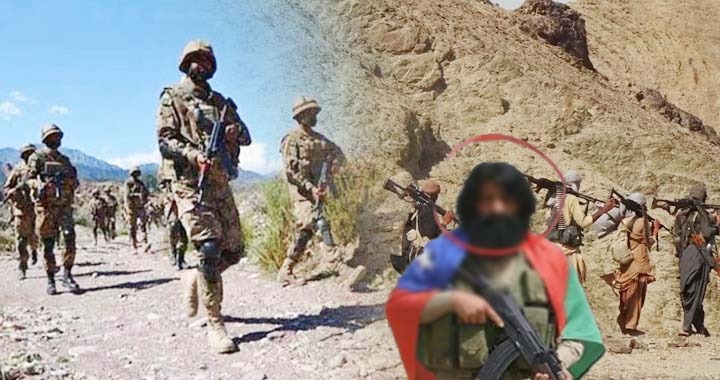
The elimination of Saqib Marri alias Sheeda, one of the key commanders of the banned Balochistan Liberation Army (BLA) in an intelligence-based operation in district Kech marks more than the removal of another militant leader. It exposes a growing structural crisis within the BLA, where sustained state pressure is hollowing out the organization’s command layer and destabilizing the networks that keep insurgency functional across Balochistan.
Security sources say Saqib Marri was wanted for multiple acts of terrorism spanning Duki, Harnai, Sibi, Ziarat, Kohlu, Mach and adjoining areas. His operational footprint extended beyond frontline violence. He was deeply embedded in extortion rackets, kidnappings for ransom, and inter-district coordination, and was identified as the mastermind behind the attack on Colonel Laiq in Ziarat Warchum. For security agencies, Marri represented the kind of militant node whose removal carries consequences far beyond a single encounter.
Why Saqib Marri Mattered to the BLA
Commanders like Saqib Marri occupy a critical space inside militant hierarchies. They are neither symbolic ideologues nor replaceable foot soldiers. They serve as the connective tissue between leadership intent and operational execution, translating strategy into violence, financing operations through coercion, and synchronizing activity across geographically dispersed cells.
The BLA’s reliance on such figures reflects its own limitations. With restricted manpower and shrinking territorial depth, the group stretches trusted commanders across multiple districts to maintain the illusion of reach. This model allows temporary operational continuity, but it also creates a single-point vulnerability. When a commander of Marri’s profile is eliminated, the disruption ripples through recruitment pipelines, financial flows, logistics and coordination simultaneously.
Kech as a Pressure Point
Kech’s growing centrality in recent operations is not incidental. Its geography, access routes and historic militant infrastructure have long made it a key zone for transit, regrouping and command coordination. By striking in Kech, security forces are not targeting the insurgency’s periphery, but its internal wiring.
The operation reflects an intelligence-driven approach that prioritizes long-term surveillance over reactive response. Saqib Marri’s ability to move across districts implied access to safe houses, facilitators and protection networks. His elimination therefore raises the operational cost for remaining commanders, forcing them to limit movement, narrow communication channels and rely on increasingly fragile support structures.
Pressure on Financing and Internal Cohesion
Beyond battlefield impact, the strike hits the BLA where it is most vulnerable, financing and internal cohesion. Extortion and kidnappings are structured enterprises, dependent on trusted intermediaries who can enforce compliance and move funds securely. Commanders like Marri act as guarantors of these systems. Without them, local cells struggle to collect, transfer and protect revenue.
This financial disruption compounds internal strain. Replacing a senior commander is not a simple succession exercise. It introduces rivalry, mistrust and fragmentation, particularly in an organization already under sustained intelligence pressure. New commanders must rebuild local alliances while remaining hidden, a balance that becomes harder as surveillance tightens.
A Broader Pattern in Balochistan
Saqib Marri’s killing aligns with a wider trend visible across Balochistan. Recent operations against BLA and BLF figures, including criminal-turned-commanders and externally supported cells, show a shift from chasing attacks to dismantling the architecture that enables them. Militancy is increasingly drawing recruits from criminal ecosystems, not political mobilization, a sign of ideological exhaustion rather than expansion.
At the same time, pressure is narrowing escape options. Commanders are being eliminated before they can relocate, and urban concealment strategies that once offered anonymity are proving temporary at best. The result is an insurgency forced inward, defensive, and increasingly fragmented.
What the Kech Operation Ultimately Signals
The elimination of Saqib Marri underscores a strategic message. Geographic spread and operational mobility no longer provide insulation for militant leadership. Intelligence penetration has made mid- and senior-tier commanders more vulnerable than foot soldiers, and their loss carries a disproportionate impact on insurgent capacity.
For the BLA, this trajectory is more dangerous than sporadic battlefield losses. It threatens the group’s ability to regenerate, finance itself, and coordinate violence across Balochistan. If sustained, this pressure does not merely reduce attacks, it erodes the insurgency’s structural foundations.
Kech, in this context, is not just a location. It is a signal that the battle has shifted decisively from reaction to dismantlement, and that the space for militant command in Balochistan is rapidly closing.



