
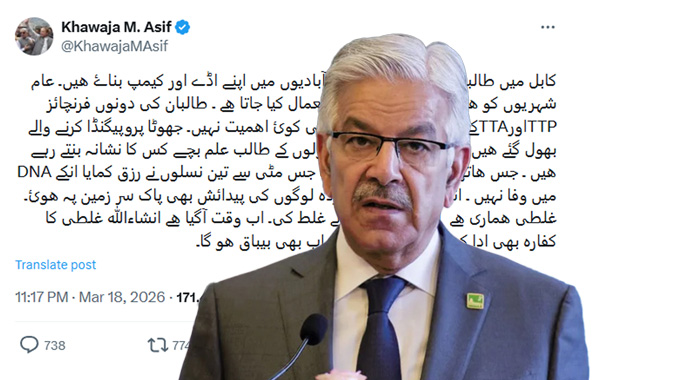
Pakistan’s Minister for Defence, Khawaja Asif, has issued a strong statement expressing grave concern over the conduct of militant groups operating from Afghan territory, particularly in and around Kabul.
In a message shared on the social media platform X, the Defence Minister alleged that Taliban authorities in Kabul have established operational bases and camps within densely populated civilian areas. He further stated that non-combatants are being used as human shields, a practice that raises serious humanitarian and legal concerns under international law.
The Minister specifically referenced two groups Tehrik-i-Taliban Pakistan (TTP) and Tehrik-i-Taliban Afghanistan (TTA) describing them as aligned entities that, according to his statement, demonstrate disregard for human life. He accused these groups of targeting innocent civilians, including worshippers in mosques and schoolchildren, in past acts of violence.
Addressing what he termed as “misleading propaganda,” the Defence Minister emphasized that such narratives overlook the long history of civilian suffering caused by militant violence in the region. He reiterated Pakistan’s position that the protection of civilian life remains paramount and condemned any actions that place non-combatants at risk.
In his remarks, Khawaja Asif also reflected on Pakistan’s historical relationship with Afghanistan, noting that for decades Pakistan has extended support and hospitality to Afghan populations. He expressed regret over what he characterized as misplaced trust and policy miscalculations in the past.
“The time has come to correct our course,” the Minister stated, signaling a potential shift in Pakistan’s approach toward cross-border militancy. He underscored the government’s resolve to hold accountable those responsible for violence and to ensure that past mistakes are addressed.
The statement comes amid heightened security concerns in the region and underscores Pakistan’s call for greater accountability and cooperation to combat terrorism and safeguard civilian populations.



