
Conflicting narratives and limited verified information continue to cloud the truth behind a recent airstrike in Kabul that reportedly impacted a rehabilitation facility housed within a former military compound. As scrutiny intensifies, analysts and observers stress the urgent need for fact-based reporting, transparency, and an independent international investigation.
In conflict zones such as the Afghanistan–Pakistan region, establishing verified facts remains inherently challenging. Both sides have historically been accused of exaggeration, denial, and selective disclosures, while restrictions on journalistic access further complicate independent verification.
According to available open-source intelligence and visual analysis, the reported strike was part of a broader pattern of operations targeting former military infrastructure across Afghanistan.
Over the past several weeks, Pakistani forces are believed to have conducted a series of airstrikes aimed at former NATO-linked facilities, including arms depots, ammunition storage sites, and strategic bases. Among the reported targets was Bagram Airbase, a historically significant military installation.
On the night in question, two separate locations in Kabul were reportedly struck:
-
Siah Sang Military Sector (Syasang Base):
Visual evidence, supported by geolocation analysis, indicates that the strike resulted in secondary explosions and sustained fires—commonly associated with ammunition or explosives storage. These indicators suggest the presence of military-grade materials at the site. -
Former Camp Phoenix Complex:
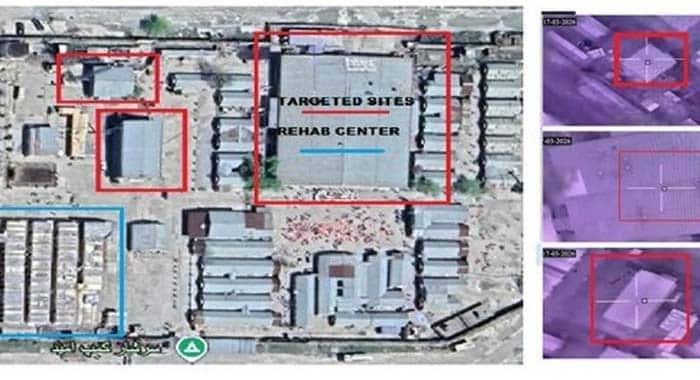
The second strike occurred within the grounds of the former NATO facility, where portions of the compound had reportedly been repurposed following the withdrawal of U.S. forces. Notably, one section of the complex had been converted into a rehabilitation center.
Footage released from the strike appears to show multiple buildings targeted within the compound. Analysis suggests that at least one structure may have contained ammunition or explosives, as evidenced by visible secondary detonations. The resulting fire is believed to have spread toward or near the rehabilitation facility.
At present, there is no conclusive evidence to confirm whether the rehabilitation center itself was an intended target. Experts caution against premature conclusions, noting that proximity to military infrastructure can significantly increase risk to civilian facilities in conflict zones.
Key questions remain unanswered:
-
Why was a rehabilitation center established within an active or partially active military complex?
-
Were weapons or ammunition stored in close proximity to civilian-use facilities?
-
Did Pakistani forces possess prior intelligence regarding the presence of the rehabilitation center?
-
Were considerations of proportionality and civilian risk adequately assessed?
Legal experts emphasize that, regardless of intent, the incident raises serious concerns under international humanitarian law. If the facility was knowingly targeted, it could constitute a grave violation. Conversely, if it was struck unintentionally due to inadequate intelligence or planning, it may still amount to negligence with severe consequences.
The incident has received widespread international attention, with outlets such as BBC News, Reuters, and Al Jazeera reporting on the destruction of the rehabilitation facility.
However, analysts argue that much of the coverage has focused narrowly on the humanitarian impact while omitting critical operational context particularly the simultaneous strike on the Siah Sang military sector and the broader pattern of ongoing air operations.
“Context is not justification, but it is essential for understanding intent, scale, and operational patterns,” said a regional security analyst. “Excluding parallel strikes risks presenting an incomplete and potentially misleading picture.”
The framing of the incident as a deliberate targeting of a civilian rehabilitation center has been questioned by some observers, who note that the facility’s location within a former military compound is a significant factor that warrants consideration.
Pakistan’s decision to release footage of the strike shortly after the incident has also drawn attention. Some analysts interpret this as an indication that the operation was not intended to conceal outcomes, while others caution that such material could later be subject to legal scrutiny.
Preliminary assessments suggest that the strike may have been part of an ongoing campaign targeting military infrastructure, particularly former NATO facilities believed to house weapons or logistical assets. However, without independent verification, these assessments remain provisional.
Experts and observers across the board agree on one point: only a credible, independent international investigation can establish the facts, determine accountability, and assess whether violations of international law occurred.
The Kabul incident underscores the complexity of modern conflict, where military targets and civilian spaces often overlap, and where narratives can shape perception as much as facts. As competing claims continue to emerge, the need for rigorous, transparent, and contextualized reporting has never been more critical.
Until verified findings are available, conclusions regarding intent, responsibility, and legality remain subject to ongoing investigation.



