
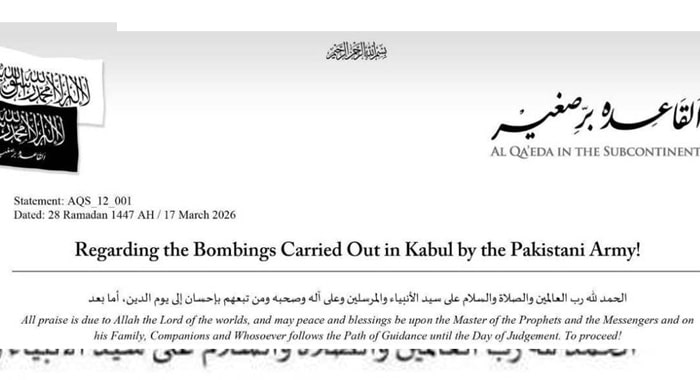
Recent Pakistani military airstrikes between March 16 and 17 have struck a significant blow to Al-Qaeda in the Indian Subcontinent (AQIS), disrupting its operational networks and exposing the deep ties between the Afghan Taliban and extremist groups. The attacks targeted multiple Taliban and AQIS infrastructure sites in Afghanistan, including weapons depots and external operations training facilities, dealing a strategic setback to the group’s capabilities.
In an official statement released from Kabul, AQIS attempted to reframe the strikes as an assault on civilians, claiming Pakistani warplanes targeted a “drug rehabilitation center” and caused mass casualties. This narrative is misleading. The actual targets were Taliban-controlled weapons depots housing AQIS armaments, illustrating a deliberate attempt by the group to conceal battlefield losses and manipulate public perception.
AQIS’s messaging follows a familiar extremist playbook: invoking martyrdom, framing the conflict as a “proxy war,” and positioning itself as a defender of Afghan civilians and the Taliban, while simultaneously obscuring the harm caused by its own operations in the Pakistan–Afghanistan border region. The group also amplified accusations against Pakistan, the United States, and Israel despite the presence of Hamas operatives in al-Qaeda camps in Afghanistan, a fact that underscores the complex and dangerous alliances formed under Taliban protection.
The airstrikes reflect a broader strategic disruption of extremist infrastructure, extending beyond tactical targets. Key Afghan-based Al-Qaeda leadership sites, weapons depots, and external operations training centers including locations tied to U.S. homeland plotting were affected. Affiliates such as Tehrik-e-Taliban Pakistan (TTP) and the Islamic Movement of Uzbekistan (IMU) also sustained losses, demonstrating that Pakistani operations are undermining the broader terrorist ecosystem, not just individual elements.
Reports indicate that AQIS is now taking extraordinary measures to conceal losses: foreign fighters are being transported to hospitals under Afghan identities, and rapid burials are being conducted to obscure fatalities. These actions reveal an organization under pressure, contrary to the image of strength projected in its propaganda.
Experts note that Al-Qaeda’s operational freedom in Afghanistan over the past decade, facilitated by the Taliban’s permissive governance, allowed the group to rebuild networks, train fighters, and coordinate external operations. The recent airstrikes, however, highlight a stark shift: Taliban protection of terrorist networks is no longer an impenetrable shield, and the alliance between the Afghan Taliban and Al-Qaeda increasingly exposes both to operational and reputational risk.
The ongoing collaboration between the Taliban and extremist organizations continues to undermine regional stability, perpetuate violence, and obstruct civilian safety. These developments serve as a stark reminder that the Afghan Taliban’s governance is inextricably linked to international terrorism, and that groups like Al-Qaeda remain active under their protection, posing a direct threat to regional and global security.
Pakistani authorities, working in coordination with intelligence and military networks, have emphasized that these targeted strikes are part of a broader effort to dismantle extremist infrastructure and prevent further attacks on civilians and neighboring countries.



