
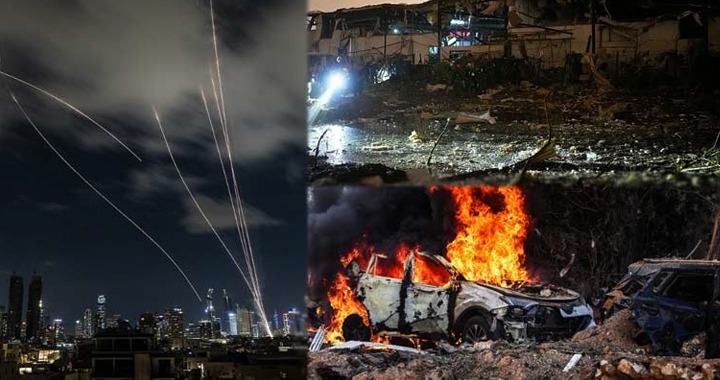
Iran has carried out a series of precision-guided missile and drone strikes targeting Israeli and U.S. military and strategic positions, marking a dramatic escalation in regional hostilities. The attacks, described by Iranian authorities as part of Operation Wada-e-Sadiq 4, were conducted in memory of Rear Admiral Ali Reza Tangsiri, the late naval chief of the Iranian Revolutionary Guard Corps (IRGC).
According to the IRGC spokesperson, the 93rd wave of Operation Wada-e-Sadiq included missile strikes on northern and central occupied Israeli territories, hitting military and logistical support centers. Targets reportedly included areas in Western Galilee, Haifa, Kafr Kanna, and Kiryat, where Iranian forces claimed to have accurately struck critical installations.
Iranian sources assert that Israel’s intelligence agency Mossad headquarters in Tel Aviv was among the primary targets. Media reports indicate that explosions and large fireballs were observed near tall buildings, creating widespread alarm. Civilian reports suggest that residents attempted to seek shelter, including near the homes of government officials, though some shelters reportedly remained inaccessible.
In northern Israel, sirens were triggered following the strikes, with multiple structures in industrial and residential areas, including Negiov, Rosh Haayin, Petah Tikva, and Tel Aviv, reportedly damaged.
The Iranian military also reported drone attacks on U.S. military facilities across three countries. Targets included warehouses in Jordan, a battalion facility in Kuwait, and an aluminum factory in Bahrain supplying materials to U.S. forces. Iranian authorities stated that these operations were conducted in retaliation for previous attacks on Iranian civilian infrastructure, pledging proportionate responses to any future provocations.
Simultaneously, Hezbollah confirmed missile strikes against Israeli forces in southern Lebanon, including the Al-Sadr area of Aynata and the border town of Maroun al-Ras. Israeli vehicles, artillery, and positions were reportedly targeted as part of coordinated cross-border operations.
The Iranian Ministry of Health has reported that over 2,000 civilians have been killed since the start of ongoing hostilities on February 28, with more than 26,000 injured. Repeated attacks have also damaged over 600 schools and educational institutions.
Iranian forces claim to have downed multiple U.S. aircraft, including an F-35 in central Iran, an A-10 fighter in southern Iran near the Persian Gulf, and an F-15 during rescue operations involving helicopters. Conflicting reports exist regarding the fate of the pilots, with Iranian media releasing video footage suggesting at least one helicopter was set on fire and crashed following Iranian strikes, while some Western sources report successful pilot rescues.
The wave of missile and drone attacks, coupled with cross-border operations by Hezbollah, highlights the intensifying volatility in the Middle East. Analysts warn that these developments could further destabilize the region, escalate military confrontations, and risk civilian safety on a larger scale.
Iranian authorities emphasized that these strikes were carried out with precision to target military installations while framing them as retaliation for previous attacks on Iranian civilian infrastructure. Officials underscored their commitment to continued vigilance and response to any perceived threats in the region.



