
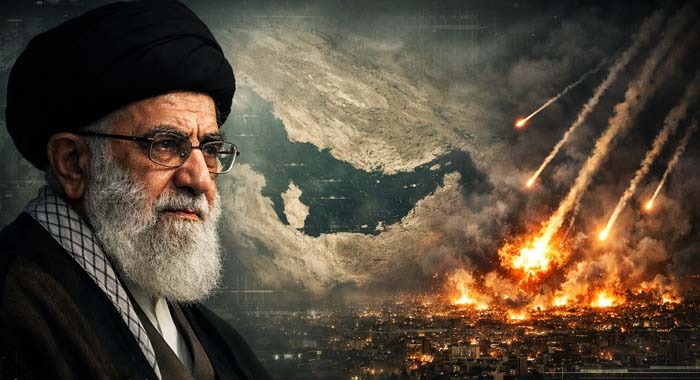
The assassination of Ali Khamenei represents a major structural disruption in West Asian strategic stability, arriving at a time when regional power competition is already highly sensitive.
Khamenei functioned as the central coordinating authority of the Iranian political, military and ideological command system. His leadership extended across state governance, foreign policy orientation and strategic defence doctrine, including supervisory influence over the Islamic Revolutionary Guard Corps, which plays a decisive role in Iran’s regional security posture.
Leadership decapitation strikes targeting a sitting strategic head of state are historically rare and carry high escalation potential. Such operations can alter battlefield calculus as well as psychological deterrence frameworks among adversarial actors. The strikes reportedly involved coordination between the United States and Israel, further intensifying geopolitical sensitivity across the region.
Iran’s response trajectory will depend largely on internal elite alignment during the succession transition. If clerical institutions, political governance mechanisms and security organizations maintain institutional coherence, Tehran may opt for controlled or calibrated retaliation rather than immediate large-scale escalation.
In wartime succession environments, security establishments often gain operational prominence. Expansion of influence by military institutions can shift state behavior toward asymmetric strategic signaling, particularly in regions already experiencing persistent security competition.
For Pakistan, the primary risk arises from indirect transmission of instability rather than direct confrontation. Islamabad continues managing security pressure along its western frontier while maintaining defensive preparedness along its eastern border. This dual-front security requirement limits Pakistan’s ability to absorb additional regional volatility.
The Pakistan-Iran border region, particularly the Balochistan corridor, remains strategically sensitive due to historical patterns of cross-border movement involving militant networks and complex terrain-based security challenges.
Internal disruption inside Iran during the transition period could weaken peripheral border coordination mechanisms, increasing the risk of localized security incidents.
Maritime security risk also remains significant. The Strait of Hormuz serves as one of the world’s most critical energy transportation arteries. Any disruption in Gulf shipping corridors could transmit economic shockwaves into Pakistan’s energy import system, potentially raising fuel price pressure and macroeconomic vulnerability.
The killing of Khamenei marks one of the most consequential leadership-targeted operations in modern West Asian history. For more than three decades, he served as the supreme authority guiding Iran’s political and strategic architecture, balancing clerical governance with state institutional interests.
The joint strike operation conducted by forces linked to the United States and Israel represents a significant escalation in targeted strategic warfare. Decapitation-style operations against high-level leadership figures introduce uncertainty into traditional deterrence theory, particularly in regions where state and non-state security interactions overlap.
Iran’s future response will be shaped by domestic institutional alignment and external strategic pressure. The role of the Revolutionary Guard is expected to remain central during the transition period, as security institutions often assume expanded authority in crisis environments.
Succession politics inside Iran is likely to involve complex clerical negotiation alongside security establishment consolidation. The selection of a new supreme leadership figure will determine Iran’s regional posture, including its approach toward asymmetric strategic projection.
Regional governments are closely monitoring transition signals because historical experience suggests that leadership shocks can produce either institutional consolidation or periods of strategic unpredictability.
For Pakistan, the development carries multi-layered security implications. Islamabad must continue balancing western frontier security operations with readiness along its eastern border, where strategic tensions periodically emerge.
Energy security remains a critical concern. Maritime routes passing near the Hormuz corridor are central to global and regional energy logistics, and any instability could influence Pakistan’s fuel import costs and macroeconomic stability.
The coming transition period inside Iran will function as a strategic test of regional security resilience. Whether the outcome produces institutional consolidation or extended confrontation will shape West Asia’s geopolitical environment for the foreseeable future.



