
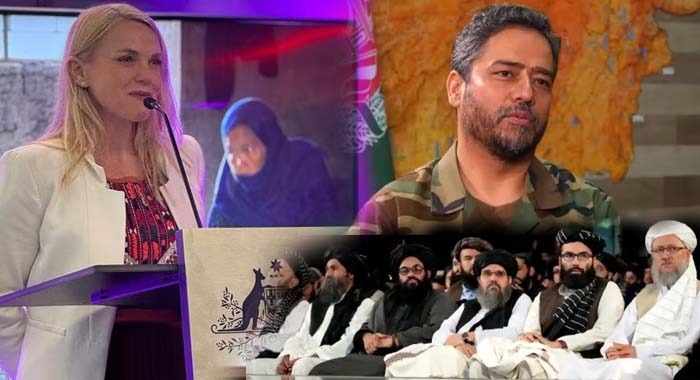
The Afghanistan Freedom Front has marked International Human Rights Day by issuing its most expansive political message since its formation, calling for an international political process that can transition Afghanistan away from Taliban rule and toward a system chosen through the people’s vote. The group reminds the world that Afghanistan was once among the earliest signatories to the Universal Declaration of Human Rights and had committed itself to major international conventions on civil, political, economic, social and cultural rights.
According to the group, the country now finds itself under a structure that neither draws legitimacy from popular choice nor respects any recognised rights framework. It describes the past four years as a period of systematic suffocation, where political participation, expression, information access, work and education have all been stripped away. The AFF’s fiercest criticism focuses on the treatment of women and girls, who it says have been removed from public life in a manner unparalleled in the modern era.
The group also argues that certain international policies, including unconditioned engagement and opaque humanitarian channels, have prolonged the current situation. It highlights the worsening plight of Afghan refugees facing deportations and violations of international refugee protections.
Its eight recommendations form a wide political framework, calling for continued non recognition of the current authorities, initiation of an international political process for transition, conditioning of humanitarian assistance, cessation of refugee deportations, support for civil society and media, creation of a mechanism to investigate violations, appointment of a UN special representative for peace and recognition of gender apartheid.
The statement is part of a pattern that has been building over the past months. Senior Afghan political leaders had already been calling for UN supervised political talks, an appeal reinforced during the recent alignment meetings where resistance fronts, political movements and civic platforms converged around principles of sovereignty, democratic governance and an inclusive future order. The Islamabad gathering earlier this year echoed the same demands, as did the plea from a former Afghan commander urging major powers to support a political transition.
In this context, the AFF’s declaration does not stand alone. It arrives as another piece in a mounting internal current that views political transition not as a distant aspiration but as an urgent and structured goal.
Outside Afghanistan: A Parallel Shift on the Global Stage
Beyond Afghanistan’s borders, political activity has accelerated around the same themes. Australia’s special envoy for Afghanistan publicly welcomed the unity emerging among various Afghan political groups, noting that common principles have finally begun to crystallise, such as national sovereignty, democratic governance and guaranteed rights for all citizens, especially women and girls.
Her remarks followed the online gathering where the High National Resistance for Salvation of Afghanistan, the National Resistance Front, the National Assembly for the Salvation of Afghanistan and the National Movement for Peace and Justice announced a coordinated stance. They emphasised direct intra Afghan negotiations, a legitimate and inclusive system shaped by the people’s will, respect for women and minority rights and transparent management of humanitarian aid.
These developments are taking place simultaneously with broader international discussions in global forums, where political alignment among Afghan actors, diaspora groups and foreign partners is being acknowledged and encouraged. This emerging space represents the first time that multiple international voices have openly framed Afghan political unity as a constructive force rather than a fragmented landscape.
In other words, the external environment has begun to mirror the internal one: both are moving toward a common vocabulary of transition, legitimacy and rights, with growing emphasis on Afghan led dialogue backed by structured international involvement.
Are the Taliban’s Days Now Entering a Countdown?
Viewed together, these two tracks, one unfolding inside Afghanistan and the other forming across the international arena, raise the central question that now hovers over Afghan politics.
The internal landscape is no longer defined by isolated statements or sporadic resistance. It has shifted into coordinated political messaging, calls for international mediation, alignment of opposition groups and a shared insistence on restoring political legitimacy. The external environment has, at the same time, begun to validate and amplify these moves, with foreign representatives endorsing unity among Afghan actors and acknowledging the need for a rights based, representative system.
This is not yet a formal roadmap to transition, but it is the closest the opposition has come in four years to building a unified political front with international resonance. For the first time since 2021, the internal and external currents are moving in parallel lines rather than in separate, unconnected streams.
Whether this constitutes a countdown depends on how these currents evolve. If the internal front consolidates further, if global actors maintain political pressure and if international processes begin to materialise around UN supervised talks, then the foundations of the current order may face sustained challenge. If these efforts dissipate into fragmented agendas, the status quo may persist.
But one change is undeniable: the political atmosphere surrounding Afghanistan no longer feels static. The language of transition is louder, the alliances are clearer and the international echo is stronger. What once appeared as a frozen landscape has begun to shift underfoot.
For the first time in four years, the question is no longer whether change is possible, but whether the emerging alignment inside and outside Afghanistan marks the beginning of a measurable countdown for the Taliban’s rule.



