
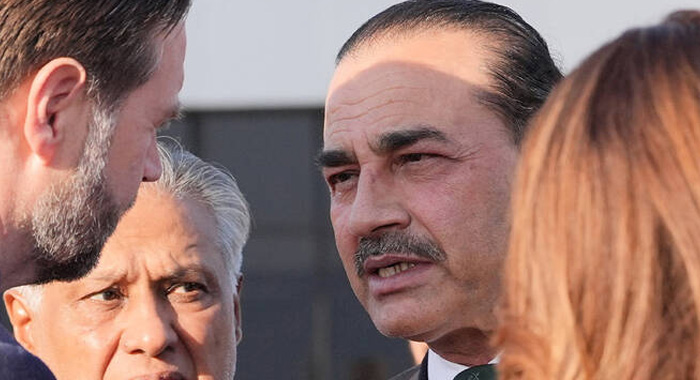
US Vice President JD Vance arrived in Islamabad on Saturday for high-level discussions aimed at facilitating dialogue between the United States and Iran, amid growing international efforts to de-escalate tensions following weeks of regional conflict.
Upon arrival, Vice President Vance was received at the airport by Pakistan’s Chief of Army Staff, Field Marshal Asim Munir, whose presence underscored Islamabad’s central role in hosting and facilitating the sensitive diplomatic engagement. The imagery of the reception highlighted what analysts describe as the increasingly prominent role of Pakistan’s military leadership in shaping the country’s external relations.
According to Islamabad-based political analyst Qamar Cheema, Field Marshal Munir has emerged as a key figure in Pakistan’s evolving diplomatic outreach. “He is a soldier, a statesman and a diplomat,” Cheema told AFP, adding that Munir has helped project a renewed international perception of Pakistan through sustained diplomatic engagement.
Pakistan’s efforts to bring Iranian and American representatives to the negotiating table for what are described as their highest-level face-to-face discussions in decades have drawn international attention and cautious praise. Officials in Islamabad have portrayed the initiative as part of a broader strategy aimed at reducing regional tensions and encouraging dialogue between conflicting parties.
Field Marshal Asim Munir was prominently involved throughout the diplomatic proceedings, receiving both delegations upon arrival and maintaining direct engagement with visiting officials. During the talks, he was accompanied by Foreign Minister Ishaq Dar, with Pakistani officials stating that both played facilitating roles in supporting dialogue between the parties.
While the discussions reportedly ended without a formal agreement, US Vice President JD Vance confirmed his departure while noting that negotiations had not yet produced a breakthrough. Pakistani officials, however, stated that engagement would continue and that Islamabad remained committed to supporting diplomatic communication channels.
The development comes amid a shifting geopolitical landscape in which Pakistan has sought to expand its diplomatic footprint. Field Marshal Munir’s role has increasingly extended beyond traditional military responsibilities, reflecting what analysts describe as a more visible military presence in foreign policy engagement.
Observers note that Munir’s international profile has grown significantly since assuming office in 2022, following a period of comparatively lower diplomatic visibility. His outreach to key global capitals, particularly Washington, has been credited with strengthening Pakistan’s engagement with the United States.
In June, Field Marshal Munir accompanied Prime Minister Shehbaz Sharif during an official visit to Washington, where he also met US President Donald Trump. That engagement has since been referenced in diplomatic and media commentary as a factor in strengthening bilateral ties. President Trump has, in public remarks, described Munir in notably positive terms, reflecting what analysts interpret as an evolving personal rapport between the two leaders.
Former intelligence chief and author Hassan Abbas noted that Munir’s growing diplomatic prominence accelerated following regional military tensions and subsequent outreach efforts in Washington. He stated that high-profile engagements, including meetings with senior US leadership, contributed to the enhancement of Munir’s international visibility.
As the US and Iranian delegations departed Islamabad, Field Marshal Munir was again present on the tarmac to see off visiting officials. While no agreement was reached, both delegations reportedly expressed appreciation for Pakistan’s role as host and facilitator of the discussions.
Pakistani officials emphasized that despite the absence of an immediate deal, efforts to encourage dialogue would continue, with Islamabad positioning itself as a constructive intermediary in regional and global diplomatic engagements.



