
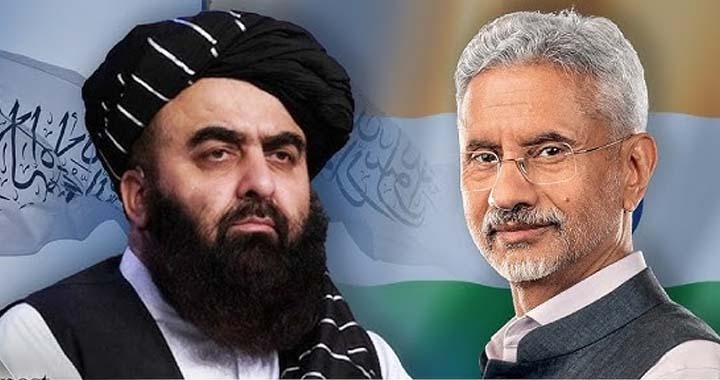
For more than two decades, India positioned itself as an implacable opponent of the Taliban. Following the US-led invasion of Afghanistan in 2001, New Delhi invested heavily in the post-Taliban political order, backing successive Kabul governments, funding infrastructure projects, and aligning itself with international efforts to prevent the return of militant rule.
That posture has now undergone a quiet but consequential reversal.
India’s decision to hand over the Afghan embassy in New Delhi to Taliban representatives, coupled with its expanding diplomatic engagement since 2022, signals a pragmatic recalibration that contrasts sharply with its earlier role in supporting the dismantling of the Taliban’s first regime. This shift, while framed as strategic necessity, is increasingly viewed through a regional security lens, particularly in Pakistan, where its implications are being closely scrutinized.
At the heart of the concern is the perception that India’s renewed engagement with the Taliban is driven by a narrow set of objectives, with destabilizing Pakistan emerging as the central one. By maintaining channels with a group that remains internationally isolated and widely accused of tolerating or enabling militant activity, India appears to be prioritizing leverage over long-term regional stability.
Since last year, Pakistani security officials and analysts have repeatedly pointed to a pattern of hostile activities they attribute to an emerging India–Taliban convergence. These include coordinated disinformation campaigns targeting Pakistan’s internal security narrative, facilitation of cross-border militant movement, and the provision of logistical support to hostile actors operating from Afghan soil.
More alarmingly, officials have cited evidence of advanced weaponry and surveillance tools, including drones, finding their way into militant hands, as well as indirect support for what Pakistani authorities describe as “hydro terrorism,” targeting water resources and critical infrastructure. While India publicly denies such allegations, the frequency and sophistication of recent incidents have intensified suspicions in Islamabad.
The paradox at the center of this alignment is striking. A Hindu nationalist government engaging with a hardline Islamist group once depicted as a global pariah underscores how strategic calculations can override ideological incompatibility. What once appeared unthinkable has become operational reality, shaped less by shared values and more by converging tactical interests.
Critics argue that this approach risks legitimizing the Taliban without securing meaningful concessions on counterterrorism or regional non-interference. By granting diplomatic access and symbolic recognition, even without formal acknowledgment, India may be contributing to a permissive environment in which militant networks feel emboldened rather than constrained.
For Pakistan, the concern is not limited to bilateral rivalry. The broader fear is that such engagement undermines collective regional efforts to contain extremism and enforce accountability. If state actors selectively normalize relations with the Taliban for short-term strategic gain, the precedent weakens international pressure mechanisms and complicates coordination against transnational militant threats.
The long-term consequences of India’s Taliban pivot remain uncertain. What is clear, however, is that a policy once anchored in opposing militant rule has given way to a transactional engagement that carries significant security risks. In a region already burdened by fragile borders, unresolved conflicts, and competing power plays, this shift adds another volatile layer to an already combustible landscape.
Whether India’s recalibration delivers strategic dividends or deepens instability will depend on outcomes that are still unfolding. For now, the India–Taliban relationship stands as a reminder that in South Asia’s security matrix, yesterday’s enemies can become today’s interlocutors, often at the expense of regional equilibrium.



