
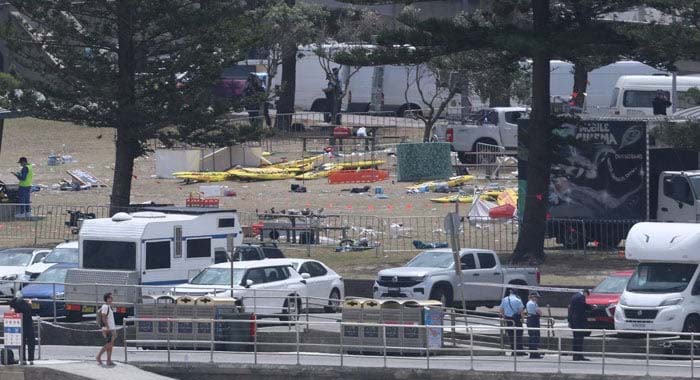
Quick to accuse Pakistan or its citizens of involvement in terrorism-related incidents abroad most recently following the Bondi Beach attack in Sydney India and its aligned media outlets face mounting questions over New Delhi’s own documented intelligence activities overseas, including espionage, assassination plots and alleged links with organised crime syndicates, according to publicly available international reports and official statements.
Australia’s national broadcaster, the Australian Broadcasting Corporation (ABC), revealed on April 30, 2024, that Australia’s domestic intelligence agency, the Australian Security Intelligence Organisation (ASIO), had dismantled a “nest of spies” in 2020 linked to a foreign power later confirmed by government sources to be India. According to ASIO Director-General Mike Burgess, the network was involved in monitoring the Indian diaspora in Australia, cultivating relationships with current and former politicians, and attempting to access classified information related to defence technology, airport security protocols and Australia’s sensitive trade relationships.
ABC reported that the espionage ring had successfully recruited an Australian government security clearance holder with access to sensitive defence information. Government and national security sources subsequently confirmed that several Indian officials were expelled by the Morrison government following the counter-intelligence operation. The Washington Post also reported that two officers of India’s intelligence agency, the Research and Analysis Wing (RAW), were expelled from Australia as part of the same operation.
ABC further noted that details of India’s clandestine activities in Australia emerged at a time when Western allies were increasingly alarmed by actions attributed to the government of Prime Minister Narendra Modi, including allegations surrounding the killing of a Sikh activist in Canada in September 2023. While acknowledging that several friendly nations engage in espionage activities in Australia, ABC specifically named India among countries under scrutiny, alongside Singapore, South Korea and Israel.
Beyond Australia, India’s intelligence agency RAW has faced public accusations from multiple countries, including Canada, the United States, Sri Lanka and Nepal, over alleged involvement in assassination plots, extrajudicial killings and interference in internal affairs.
Pakistan, in 2016, arrested Indian national Kulbhushan Jadhav, whom authorities identified as a RAW operative tasked with financing terrorist activities and sabotaging the China-Pakistan Economic Corridor (CPEC). Pakistan has consistently maintained that Jadhav’s activities were part of a broader destabilisation campaign inside the country.
In the United States, federal prosecutors in 2023 charged an Indian national in connection with a foiled plot to assassinate Gurpatwant Singh Pannun, a Sikh activist and US citizen, in New York City. Subsequent reporting by The Washington Post identified a RAW officer as being directly involved in the plot. Following these revelations, the United States Commission on International Religious Freedom recommended targeted sanctions against RAW over alleged assassination attempts on foreign soil.
Canada has emerged as one of the most vocal critics of India’s overseas intelligence operations. In 2023, then Canadian Prime Minister Justin Trudeau told parliament that Canadian security agencies were investigating “credible allegations” linking Indian government agents to the killing of Sikh separatist leader Hardeep Singh Nijjar in British Columbia. In 2024, Canadian authorities further alleged that Indian diplomats were connected to a broader “criminal network” involved in homicides, extortion and intelligence-gathering activities targeting Sikh separatists.
Canadian police specifically accused the Lawrence Bishnoi-led organised crime group of carrying out targeted killings at the behest of RAW. These allegations triggered a major diplomatic crisis, with both India and Canada expelling diplomats in tit-for-tat actions, according to the BBC. Canada’s Acting High Commissioner Stewart Ross Wheeler was summoned by India’s External Affairs Ministry in New Delhi, while Trudeau publicly stated that India had committed a “fundamental error” by allegedly supporting criminal activities on Canadian soil, asserting that the evidence presented “cannot be ignored.”
In an October 16, 2024 report, Al Jazeera highlighted further Canadian allegations linking Indian diplomatic personnel to Lawrence Bishnoi, one of India’s most notorious crime syndicate leaders. Canadian officials claimed Indian diplomats collected intelligence on Canadian citizens critical of the Modi government. Bishnoi previously gained prominence following his alleged involvement in the 2022 killing of Punjabi rapper Sidhu Moosewala and has since been linked to several high-profile criminal cases in India.
Al Jazeera also reported that Bishnoi’s gang claimed responsibility for the murder of Mumbai-based politician Baba Siddique, a three-time legislator and former Maharashtra minister, underscoring the criminal network’s expanding influence.
India’s intelligence activities have also drawn criticism in South Asia. In 2020, Nepalese media and political leaders accused RAW of interfering in Nepal’s internal political affairs. The Kathmandu Post reported that several former Nepalese prime ministers, including KP Sharma Oli, had repeatedly alleged Indian meddling in domestic governance.
A 2008 report by the US-based Council on Foreign Relations stated that RAW had provided military assistance to groups hostile to Myanmar’s pro-China regime and had previously supported the Liberation Tigers of Tamil Eelam (LTTE) in Sri Lanka during the 1970s. The report noted that RAW trained and armed Tamil fighters, attracting criticism from human rights organisations. It further documented RAW’s longstanding intelligence cooperation with Afghanistan’s KHAD and the Soviet KGB during the 1980s, primarily directed against Pakistan.
Analysts argue that this documented history of overseas covert operations and allegations of state-sponsored violence stands in sharp contrast to India’s frequent attempts to implicate Pakistan in terrorism incidents abroad, often without presenting verifiable evidence. They maintain that international scrutiny should be applied uniformly and that selective outrage undermines global counterterrorism credibility.



