
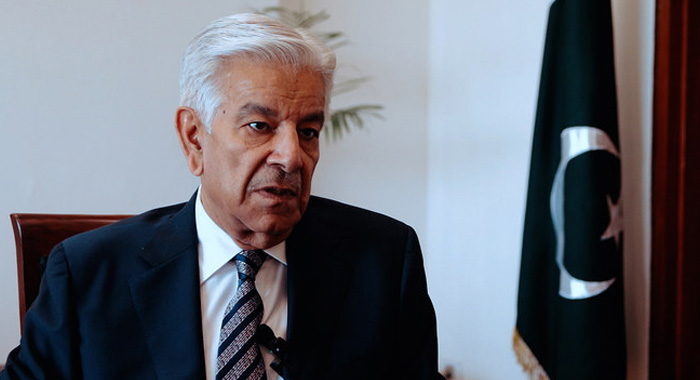
Pakistan’s National Assembly held an extensive and high-level debate on the deteriorating law and order situation in Balochistan, during which Defence Minister Khawaja Muhammad Asif delivered a comprehensive policy statement, attributing the recent wave of terrorist violence to a criminal–terror nexus operating with external support from Afghanistan and India.
Speaking on the floor of the House, the defence minister stated that the entire leadership of terrorist groups active in Balochistan is based in Afghanistan, from where they are receiving logistical, financial and operational backing. He asserted that India is actively supporting these terrorist elements, which are attempting to destabilise Pakistan through coordinated attacks and targeted violence.
The debate was initiated following the adoption of a motion to suspend routine parliamentary business to discuss the prevailing security situation. The motion was moved by Federal Minister for Parliamentary Affairs Dr Tariq Fazal Chaudhry in light of recent security operations against terrorists in the province.
In his policy statement, Khawaja Asif made it unequivocally clear that no justification or rationalisation of violence would be tolerated, and that there would be no negotiations with terrorists. He stressed that terrorist groups were using brute force against innocent civilians, including women and children, and that the state would respond to such actions with its full might.
He revealed that a well-organised criminal mafia, involved in petrol smuggling and the misuse of Afghan Transit Trade, is financing the current wave of unrest. According to the defence minister, terrorist groups in Balochistan were generating up to Rs4 billion per day through oil smuggling, and the recent escalation in violence was a direct reaction to the government’s crackdown on smuggling and criminal networks.
The minister named the Balochistan Liberation Army (BLA) and other criminal elements as key beneficiaries and patrons of these illicit activities, categorically rejecting the narrative that the violence represents a rights-based or nationalist struggle.
Describing the ongoing situation as a “great national tragedy,” Khawaja Asif informed the House that security forces continue sustained counterterrorism operations across Balochistan. He disclosed that 177 terrorists have been killed in recent operations, none of whom had any political or nationalist affiliation.
He paid tribute to the sacrifices of security personnel, noting that 17 members of the security forces were martyred, while 33 civilians lost their lives in terrorist attacks. He emphasised that such sacrifices underscore the gravity of the threat faced by the country.
Rejecting allegations of neglect, the defence minister highlighted substantial state investment in Balochistan over successive governments, particularly in education, health and infrastructure.
He noted that at the time of Partition in 1947, Balochistan had only 114 schools, whereas today the number has increased to 1,596. Similarly, higher education and technical institutions have expanded significantly, alongside major improvements in healthcare infrastructure. From just three major hospitals in 1947, the province now has 13 teaching hospitals, 33 primary healthcare facilities, 756 basic health units, 541 dispensaries, four cardiac centres and 24 dialysis centres.
Addressing the issue of missing persons, Khawaja Asif said several terrorists killed in recent operations appeared on missing persons’ lists, while others were living abroad with their families receiving financial allowances. He described this narrative as fabricated to destabilise Balochistan, questioning how these individuals were able to acquire advanced American weaponry.
He also condemned incidents in which Punjabis travelling through Balochistan were forcibly removed from buses and killed after identity checks, calling such acts part of a deliberate attempt by anti-state elements to incite ethnic hatred.
The debate saw participation from leaders across the political spectrum. Opposition Leader Mahmood Khan Achakzai called for reducing political distance between state institutions and elected representatives, describing Balochistan as a long-standing “blind spot” and urging the strengthening of Parliament. He emphasised the need to address ground realities and criticised past policies that, in his view, marginalised common citizens.
Following his remarks, National Assembly Speaker Sardar Ayaz Sadiq ruled that any comments against security forces and intelligence agencies be expunged from the official record, paying tribute to their sacrifices for national security.
Responding, Khawaja Asif reflected on Pakistan’s past involvement in regional conflicts, stating that the country was now paying a heavy price for earlier strategic decisions. He disclosed that he had previously visited Kabul and offered Rs10 billion in financial assistance, without receiving guarantees in return.
“The time does not demand criticism,” the defence minister said. “It demands unity and solidarity from this House.”
Former prime minister Raja Pervaiz Ashraf described terrorism as a grave injustice that had caused immense suffering and warned against ethnic hatred, calling violent acts part of a broader conspiracy against the country. PTI Chairman Barrister Gohar Ali Khan affirmed that the entire House stood united in condemning terrorism and pledged that Pakistan would continue its fight until the last terrorist is eliminated.
Lawmakers from PPP and JUI-F, including Jamal Raisani, Alia Kamran, Mian Khan Bugti and Shahida Akhtar Ali, echoed similar sentiments, rejecting any portrayal of terrorism as a rights movement and pledging full political support for counterterrorism efforts.
Concluding the debate, the overarching message from the National Assembly was one of national unity, resolve and collective responsibility. Lawmakers reaffirmed that terrorism poses an existential threat to Pakistan and can only be defeated through a united political front, public support, and unwavering commitment to national security.



