
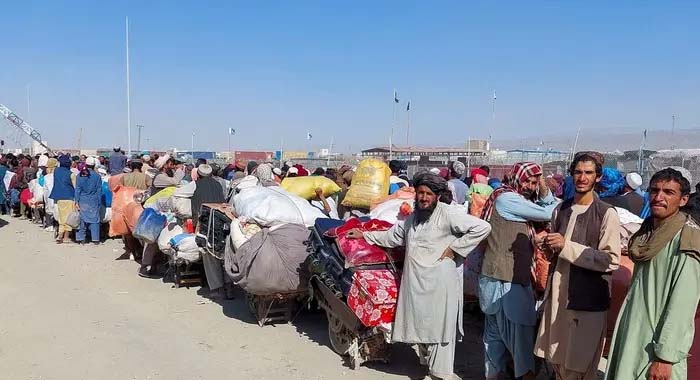
The large number of illegally residing Afghan nationals in Khyber Pakhtunkhwa is increasingly affecting the province’s security, economy, and public services, officials and research reports indicate. The presence of undocumented Afghan residents is putting a direct burden on provincial resources, social infrastructure, and public facilities. According to the Eurasia Review, approximately 1.7 million undocumented Afghan nationals and 1.3 million registered Afghan refugees have impacted housing, health, education, and employment sectors in Pakistan.
Research conducted by the German Development Institute (SDPI) shows that the influx of Afghan refugees has affected access to educational services for 30 percent of the provincial population and healthcare services for 58 percent. The South Asia Times reports that the additional population burden has also contributed to rising unemployment, placing local economic activity under pressure. Several Afghan traders in Khyber Pakhtunkhwa have reportedly accumulated wealth without paying taxes, affecting Pakistan’s revenue collection.
Overall, the reports indicate that the large-scale arrival of Afghan refugees has had a negative impact on both the short-term and long-term economic development of the province. The excessive use of natural resources by refugee populations has also intensified environmental challenges.
In response, the federal government initiated the third phase of a phased plan to deactivate 54 Afghan refugee camps nationwide. Of these, 43 were located in Khyber Pakhtunkhwa, 10 in Balochistan, and one in Punjab. While Punjab and Balochistan have largely complied with federal directives—Punjab cleared its only camp in Mianwali and Balochistan has made significant progress with its ten de-notified camps—Khyber Pakhtunkhwa has lagged behind in implementation.
Only two of the 43 de-notified camps in Khyber Pakhtunkhwa have been fully vacated, while camps in Nowshera, Peshawar, Khyber, Kohat, and North and South Waziristan continue to receive electricity, water, health, and other facilities. Authorities have highlighted that effective enforcement of the federal policy, including the implementation of the IFRP (Integrated Framework for Refugee Policy), is essential for safeguarding public resources and maintaining law and order in the province.
The situation in Khyber Pakhtunkhwa remains a pressing concern, underscoring the urgent need for coordinated action between federal and provincial authorities to manage the refugee population and protect provincial infrastructure, economic stability, and public welfare.



