
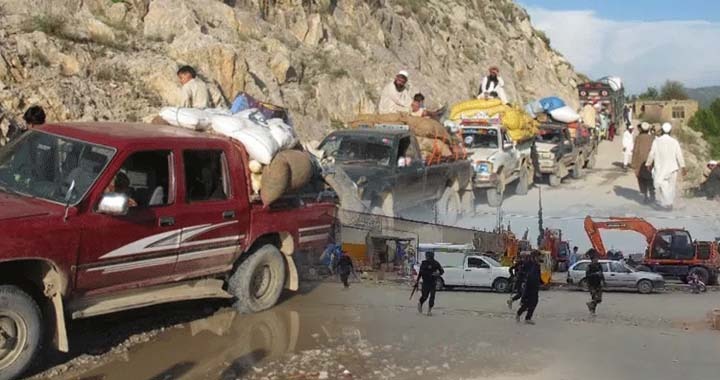
Recent population movement from Tirah Valley to Bara has brought into focus a series of critical ground realities, shedding light on how terrorist groups operate, adapt, and sustain their presence through local dynamics.
Security-linked assessments indicate that the temporary displacement of residents from Tirah has significantly altered the pattern of terrorist activity in the region. When civilian populations were present in Tirah, terrorists frequently used residential areas as cover, launching attacks from within homes and blending into local communities. With the departure of residents, this cover diminished, leading to a sharp decline in attacks in the area.
Verified data supports this shift. In the six months prior to November 2025, Tirah witnessed approximately 369 terrorist incidents. However, following the temporary relocation of the tribes, only 46 incidents were reported over the subsequent four months, with no martyrdom recorded during that period.
The Shift of Violence
While Tirah saw a relative improvement in security, Bara experienced the opposite trend.
Before the displacement, Bara recorded 21 terrorist incidents between June and November 2025, with only one martyrdom. In contrast, the four months following the migration saw a surge to 54 incidents and seven martyrdoms, indicating a clear shift of threat.
Security officials assess that terrorists moved alongside displaced populations, re-establishing themselves in Bara and surrounding areas. Reports now suggest visible movement of terrorists in certain local routes, a development considered unlikely without some degree of local facilitation.
Human Shields and Local Support
A key takeaway from these developments is the reliance of terrorist groups on civilian populations as human shields. In Tirah, terrorists had long embedded themselves within inhabited areas, using homes and communities to conceal movement and operations.
One notable incident occurred on September 22, 2025, in the Aka Khel Shadlah area of Tirah, where an explosion inside a terrorist hideout resulted in the deaths of 14 terrorists. Tragically, 10 civilians, including women and children, also embraced martyrdom. The incident was later misrepresented as a security forces action, despite clear indications that terrorists had been operating from within civilian structures.
Equally significant is the role of local facilitation. In Tirah, certain tribal support networks reportedly enabled terrorists to sustain operations. As populations relocated, these support structures effectively shifted as well, allowing terrorist elements to embed themselves in Bara.
An Expanding Network
The situation in Bara is further complicated by the intersection of terrorism with criminal economies. Terrorists are believed to be linked with narcotics trafficking, illicit trade, and organized crime networks, providing them with logistical support, safe havens, and mobility.
This convergence has effectively turned Tirah and Bara into interconnected zones within a broader network, where terrorism and criminality reinforce each other.
A Clear Pattern Emerges
The contrasting trends between Tirah and Bara underscore a critical reality: terrorist activity is closely tied to the availability of local support systems and civilian cover. Where these exist, threats intensify; where they diminish, terrorist operations are constrained.
Recent developments also highlight the importance of timely local intelligence. Delayed reporting or deliberate inaction at the community level creates space for terrorist regrouping, making facilitation one of the most significant enablers of their survival.
Security experts conclude that the temporary displacement from Tirah disrupted terrorist networks in that area. However, as populations moved to Bara and adjoining areas, terrorist elements followed, exploiting familiar social and logistical environments to re-establish their presence.
The evolving situation serves as a stark reminder that counterterrorism is not solely a kinetic challenge but also a societal one, where community awareness and cooperation remain central to long-term stability.



