
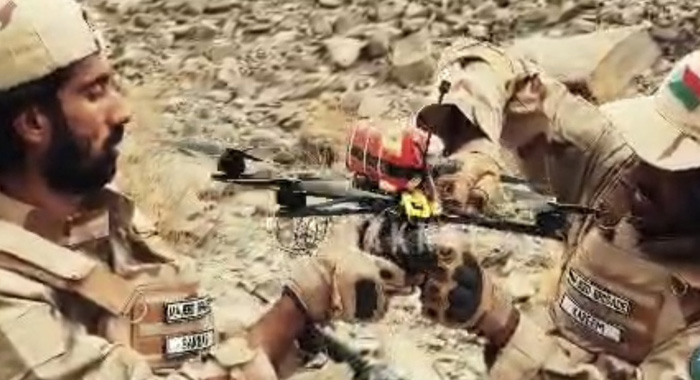
Emerging intelligence assessments point to a concerning transformation in the operational capabilities of militant groups active in Balochistan, driven by the convergence of abandoned military hardware, commercially available drone technology, and entrenched cross-border smuggling networks.
According to multiple security sources, the Balochistan Liberation Army (BLA), referred to in some reports as “Fitna al Hindustan,” has reportedly acquired advanced drone systems transported through Afghan territory. Allegations circulating within security circles suggest possible facilitation by India, along with claims of sponsorship from a Middle Eastern country. These assertions remain under investigation and have not been independently verified.
The reported use of such drones during the recent failed “Operation Herof 2.0” signals a broader tactical shift: the blending of low-cost commercial platforms with military-grade accessories to achieve disproportionate battlefield impact. Analysts describe this development as a “hybridization of insurgency,” in which irregular groups leverage accessible technology to narrow the gap with state security forces.
Recent counter-terror operations have resulted in the recovery of significant quantities of advanced equipment, including U.S.-manufactured night vision goggles, laser range finders, and other specialized tactical gear. Much of this matériel is believed to have originated from stockpiles left behind following the withdrawal of the United States Armed Forces and NATO from Afghanistan. The unintended proliferation of this equipment has created a secondary security challenge, as surplus assets circulate through informal markets and illicit supply chains.
Intelligence findings identify three principal land corridors facilitating the movement of drones and military equipment into Balochistan:
-
Helmand / Kandahar → Spin Boldak / Chaman → Quetta:
Utilizing semi-developed roads and blending with routine commercial traffic, this route enables discreet transportation of compact systems such as drones and optical equipment. -
Nimroz / Helmand → Panjgur → Turbat / Mand:
Historically associated with narcotics trafficking, this corridor has reportedly diversified into multi-commodity smuggling, including weapons components and aerial systems. -
Paktika / Khost → Zhob Ridge:
A mountainous and logistically demanding passage where a major infiltration attempt was foiled in 2025, highlighting both the persistence of smuggling attempts and the increasing vigilance of security forces.
Security officials emphasize that the small size and civilian appearance of many commercial drones significantly complicate detection. Platforms such as the DJI Mavic 3 and the DJI Matrice series, along with improvised first-person-view (FPV) drones, have reportedly been adapted for aerial reconnaissance, real-time targeting support, and, in isolated instances, the delivery of explosive payloads.
Experts warn that the central issue extends beyond any single actor or route. The broader challenge lies in the intersection of three destabilizing factors:
-
Technological Accessibility: Commercial drones are widely available, affordable, and easily modified.
-
Residual Military Stockpiles: Abandoned advanced equipment enhances night operations and targeting precision.
-
Established Smuggling Networks: Longstanding trafficking corridors provide ready-made logistics pipelines.
This convergence represents a structural shift in the regional security environment, where non-state actors can integrate off-the-shelf technology with legacy military hardware to conduct increasingly sophisticated operations.
Authorities reiterate their commitment to strengthening border surveillance, enhancing counter-drone capabilities, and pursuing intelligence-led operations aimed at dismantling procurement and transport networks. Regional cooperation and improved oversight of surplus military equipment are viewed as essential components in preventing further proliferation.
As investigations continue, officials underscore the importance of measured analysis, verified information, and coordinated action to address the evolving security landscape without contributing to unnecessary regional escalation.



