
Afghan nationalist circles frequently invoke the slogan of a “5,000-year-old history” to assert civilizational depth while contrasting it with Pakistan’s relatively recent emergence as a modern state in 1947. The argument is rhetorically effective but historically flawed. It relies not on objective scholarship, but on selective memory, anachronism, and the conflation of ancient civilizations with modern nation-states. When history is examined honestly, the narrative of an ancient Afghan state collapses under its own weight.
The most fundamental fact often ignored is that Afghanistan, as a political entity, is a modern creation. Prior to 1747, there was no sovereign state known as Afghanistan. The foundations of the modern Afghan state were laid by Ahmad Shah Durrani, whose empire unified disparate tribal territories following the decline of Persian and Mughal authority in the region. Before this period, the lands now called Afghanistan were governed by a succession of empires Achaemenid, Greco-Bactrian, Kushan, Sassanian, Ghaznavid, Ghorid, Timurid, Mughal, and Safavid—none of which constituted an Afghan nation-state in the modern sense.
Ancient civilizations did exist in and around the region, but civilizations are not nation-states. The Indus Valley, Gandhara, Bactria, and Arachosia were cultural and economic zones that transcended modern borders. Claiming them exclusively for a present-day nationalist narrative is intellectually dishonest. By that logic, multiple modern countries could lay claim to the same ancient past.
The contradiction becomes even clearer when examining Pashtun regions often cited in Afghan nationalist rhetoric. Areas such as Swat, Mardan, Peshawar, and the Yusufzai plains were never part of Afghanistan at any point in history. Swat existed as an independent princely state until it acceded to Pakistan after 1947. Mardan and Peshawar remained districts of Punjab under British administration until 1901, when the North-West Frontier Province (NWFP) was created. These regions were never ruled from Kabul, nor were they administratively or politically integrated into any Afghan polity.
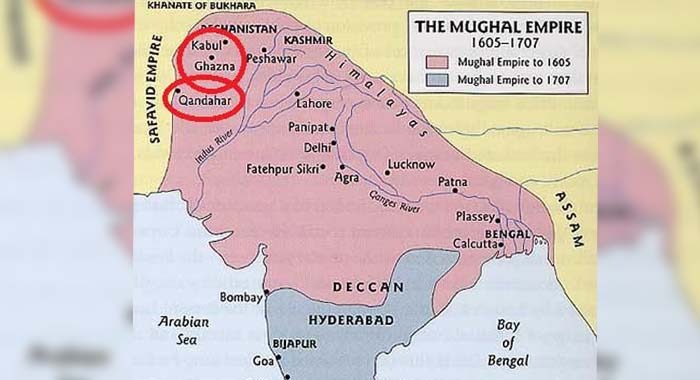
Ironically, the historical record shows the reverse relationship more clearly. In 1580, the Mughal Empire formally incorporated Kabul as a province of Hindustan. For centuries thereafter, Kabul functioned as part of the subcontinental political, administrative, and economic system. Mughal princes governed it, subcontinental trade routes passed through it, and its elite was deeply embedded within Indo-Persian culture. Kabul was not an external frontier—it was an integral part of a broader South Asian imperial space.
This historical reality exposes a deeper inconsistency. If sovereignty claims are to be justified on the basis of ancient civilizational continuity, then the same argument would place Kabul and Kandahar within the historical geography of Hindustan, whose successor state today includes Pakistan. Pakistan does not advance such claims, precisely because modern international borders are not determined by medieval or ancient empires. Yet Afghan nationalist discourse selectively invokes antiquity only when it appears politically advantageous.
The comparison with Pakistan’s age is therefore misleading. Pakistan does not deny its modern political formation, but its civilizational roots Indus Valley, Gandhara, centuries of Muslim rule, and deep historical continuity are as ancient as any in the region. The difference is that Pakistan does not confuse civilization with statehood. Afghanistan’s rich cultural history is undeniable, but its nation-state is no older than many others created in the eighteenth and nineteenth centuries.
National myths, while emotionally powerful, become dangerous when they distort historical fact and fuel unrealistic territorial or political expectations. History, properly understood, reveals a region shaped by overlapping empires, fluid identities, and shifting borders not by timeless nation-states frozen in antiquity.
An honest reading of history does not diminish Afghanistan’s cultural heritage, nor does it elevate Pakistan at its expense. It simply exposes the fallacy of using selective antiquity as a political weapon. Sustainable regional relations will only emerge when history is treated as a source of understanding not as a tool for nationalist mythology.



