
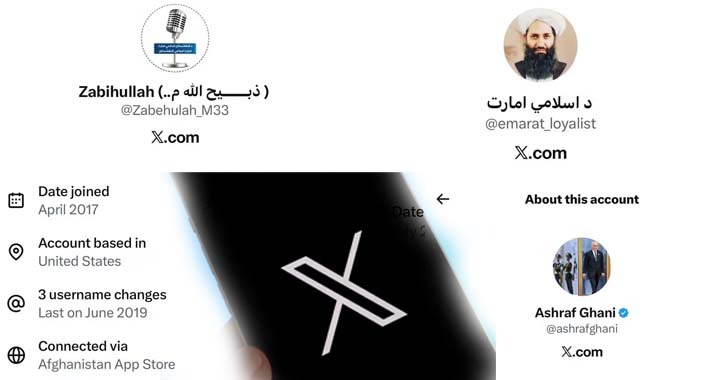
A newly launched feature on the social media platform X has exposed the true locations of numerous accounts linked to Taliban leaders, their supporters, and former Afghan government officials, revealing a wide-reaching network operating far beyond Afghanistan. The feature lifts the veil on the online activity of those in power and the significant resources invested in global information campaigns.
A detailed review of these accounts indicates that users who claim to be in Afghanistan; or elsewhere, are often operating from countries such as the United States, United Kingdom, France, the Netherlands, India, Austria, and Norway. Many of these accounts are systematically promoting pro-Taliban messaging, highlighting the extent of digital influence campaigns across continents.
Among the most striking revelations is the account of Zabihullah Mujahid, spokesperson for Taliban leader Hibatullah Akhundzada. With over one million followers, Mujahid’s account shows activity from the United States. While there are no reports of him travelling to the US, possibilities include management of the account by a US-based handler, recent access from an American IP, or VPN use—though widespread VPN usage in Afghanistan is considered unlikely. Notably, Mujahid’s account activity involves an iPhone, a high-end device that contrasts sharply with the Taliban’s promoted image of modest living.
Similarly, the official account of the office of Abdul Ghani Baradar, the Taliban’s deputy prime minister for economic affairs, is managed from the United Kingdom, despite no confirmed visits by Baradar to London. The account of the Taliban embassy in Moscow is reported to be accessed from Austria via the US Apple App Store, and Ahmadullah Wasiq, head of the Taliban’s Physical Education Directorate, is also operating from the United States.
Abdul Qahar Balkhi, spokesperson for the Taliban’s Ministry of Foreign Affairs, shows account activity from India, coinciding with his recent participation in Taliban–Pakistan negotiations in Istanbul. This location is notable given longstanding allegations of collaboration between the Taliban and Indian authorities to support anti-Pakistan armed groups.
Pro-Taliban influencers in Europe were also identified. Accounts in France, Norway, and other European nations actively promote Taliban narratives, repost official speeches, and disseminate political content. Notable users include Abdul Salam Mujahid, active in France with over 7,000 followers, and Shaheen Durrani in Norway, with more than 10,000 followers. Some accounts claim to be Afghanistan-based but are operating from European countries, further demonstrating the transnational reach of these information networks.
Accounts belonging to former Afghan government officials are similarly revealing. Former president Ashraf Ghani’s account, previously shown as managed from the Netherlands, is now accessed from the United Kingdom. Abdullah Abdullah, former chairman of the High Council for National Reconciliation, is also operating from the UK, while Hanif Atmar, former foreign minister and national security adviser, appears active from Germany. Accounts of Ahmad Massoud, leader of the National Resistance Front, and former vice-president Amrullah Saleh are shown to be active from Central Asia, reportedly Tajikistan.
X has cautioned that location data can be influenced by temporary stays, travel, or VPN usage. Nevertheless, the platform’s head of product, Nikita Bier, confirmed that the information is “99 percent accurate.” The feature, first conceptualised in 2018, was introduced to increase transparency and reveal accounts operating under false identities to advance political agendas or gain notoriety.
The new revelations underscore the global footprint of Afghan political actors and the sophisticated transnational strategies used to influence narratives. From Washington to London and beyond, the digital traces of Taliban leaders, supporters, and former officials provide an unprecedented view of how information campaigns are orchestrated and amplified across continents.



