
Operation Ghazab Lil Haqq is no longer a border response mechanism. It is evolving into a layered, theatre-wide counterterror doctrine stretching from South Waziristan to Balochistan, from Peshawar’s police stations to reported airstrikes deep inside Afghanistan.
The pattern that now emerges is not reactive firefighting. It is synchronized pressure.
The Western Spine: South Waziristan and Command Signaling
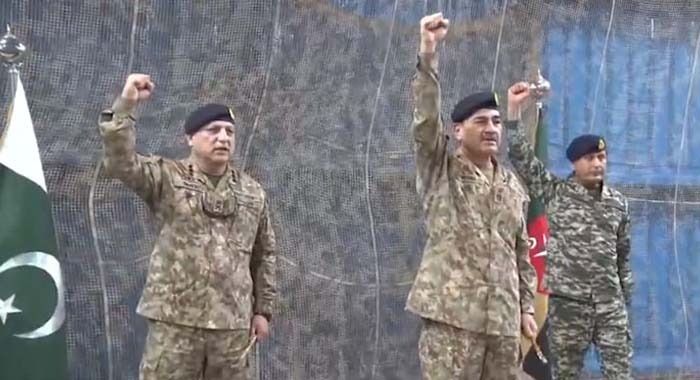
Field Marshal Syed Asim Munir’s visit to Wana was more than ceremonial oversight. In conflict environments, senior command presence at forward zones serves as strategic punctuation. His review of operational readiness, border management and intelligence-based operations signaled institutional consolidation behind the campaign.
Publicly reiterating that Afghan soil cannot be used for attacks against Pakistan established the political boundary condition of the operation. The message was clear, deterrence is now operational, not rhetorical.
Urban Shield: Bannu and Peshawar
While artillery thundered along the frontier, domestic vigilance remained critical.
The defusing of a five-kilogram remote-controlled IED in Bannu prevented what could have been mass-casualty disruption along a public highway. The bomb’s configuration, detonators, battery, circuit system, indicates intent to target either security convoys or civilian traffic. That incident reflects a parallel front, asymmetric retaliation within settled districts.
In Peshawar, coordinated attacks on police facilities in Nasir Bagh and Mattani were repelled with no fatalities. The attempted rocket strike and subsequent armed assault suggest militant probing of urban defensive layers. Rapid containment demonstrated that response protocols are functioning under stress.
Together, Bannu and Peshawar show that while cross-border operations intensify, internal hardening is keeping pace.
Balochistan: Expanding the Battlespace
The Chaman sector operations and the large-scale March 3–4 campaign across more than fifty locations in Balochistan mark a significant geographic widening.
Heavy artillery, anti-tank guided missiles, swarm drones and armored deployments indicate not merely search-and-clear missions but area dominance objectives. Targeting sectors across Kalat, Zhob, Nushki and the Chiltan ranges reflects a comprehensive sweep aimed at dismantling logistical corridors allegedly linked to cross-border militancy.
In Ornach, the elimination of 14 militants affiliated with the Fitna al Hindustan faction of the BLA adds another dimension. The western security doctrine is no longer compartmentalized between TTP-aligned factions and Baloch insurgent networks. The operational framing suggests convergence, viewing disparate militant entities as components of a broader destabilization matrix.
Cross-Border Air Power: The Afghanistan Dimension
International reporting citing over 50 airstrikes within a week, including reported targeting of installations at Bagram Air Base, if accurate, signals escalation in vertical depth.
Air power changes strategic geometry. It compresses sanctuary space and forces adversaries into mobility cycles. Satellite imagery cited by international media indicating damage to hangars and warehouses, alongside official emphasis on targeting Fitna al Khawarij elements, frames these strikes as counterterror precision rather than broad punitive raids.
If sustained, such aerial operations reduce predictability for cross-border facilitators.
Midway Assessment: Integrated Pressure Architecture
What distinguishes this phase is integration.
Command oversight at forward zones
Urban counter-sabotage successes
Multi-division operations in Balochistan
Artillery retaliation along Kurram and Torkham
Reported air campaigns targeting strategic depth
This resembles a pressure architecture rather than isolated tactical bursts.
Each domain reinforces the other. Border retaliation deters infiltration. Urban resilience denies psychological victories. Balochistan sweeps disrupt rear logistics. Air operations challenge external sanctuaries.
Risk and Sustainability
The breadth of operations raises sustainability questions.
High-tempo artillery, drone deployment and mechanized movements demand logistical endurance. Urban counterterror vigilance requires continuous intelligence refresh cycles. Cross-border air power invites diplomatic friction and potential escalation.
However, the synchronized tempo suggests preparation rather than improvisation.
Strategic Implications
Three strategic signals emerge:
First, sanctuaries are shrinking. Whether in mountainous corridors, desert expanses or across the border, mobility is being contested.
Second, messaging has shifted from warning to execution. Public articulation of Operation Ghazab Lil Haqq is now paired with demonstrable action.
Third, the conflict’s geography is flattening. What once appeared as localized insurgencies are being addressed under a unified operational umbrella.
From the martyrs’ memorial in Wana to the bomb disposal site in Bannu, from the rocky ridges of Ornach to the reported craters at Bagram, Operation Ghazab Lil Haqq now reads less like a single campaign and more like a doctrine in motion.
The question ahead is not whether operations will continue. It is whether sustained, multi-front pressure can permanently fracture the networks it targets.
On Pakistan’s western arc, the tempo has changed. The frontier is no longer a line on the map. It is an active system under recalibration.



