
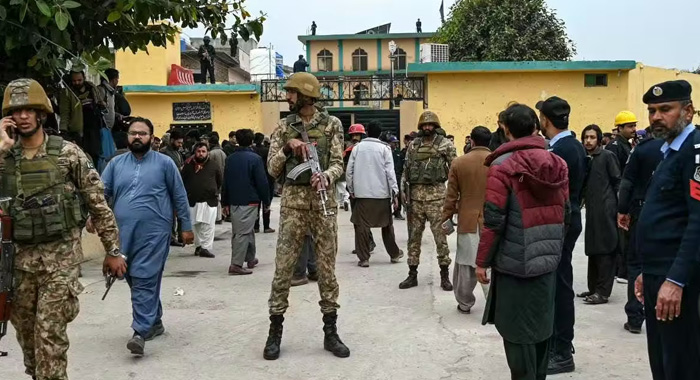
Pakistan is mourning a devastating act of terrorism after a suicide bombing struck Imambargah and Mosque Khadijat-ul-Kubra in Islamabad during Friday prayers, killing more than 30 worshippers and leaving nearly 200 injured, many of whom remain in critical condition. Authorities have warned that the death toll may rise.
The attack comes at a time when the nation was still reeling from a series of coordinated terrorist assaults across 12 locations in Balochistan, which claimed the lives of more than a dozen Pakistan Army personnel and civilians. The latest incident has intensified national grief and heightened concerns over the expanding reach of militant violence.
According to initial police and security reports, two terrorists attempted to carry out the attack. Security personnel stationed at the mosque confronted the assailants as they attempted to move toward the front prayer rows. During an exchange of gunfire, one attacker detonated himself at the entrance gate, while the second managed to flee. Officials stated that had the attackers succeeded in reaching the center of the mosque, the scale of casualties could have been significantly higher.
The banned terrorist organization Daesh (ISIS) has claimed responsibility for the attack.
President, Prime Minister, provincial governors, chief ministers, federal ministers, and political leaders across Pakistan strongly condemned the attack, expressing deep sorrow over the loss of innocent lives. They extended condolences to the families of the martyrs and reiterated the state’s resolve to continue the fight against terrorism until its complete eradication.
Punjab Chief Minister Maryam Nawaz Sharif cancelled all official and public engagements, including cultural events scheduled for Saturday, in solidarity with the victims.
The attack has drawn widespread international condemnation, with Saudi Arabia, Iran, the United States, Russia, the United Kingdom, China, and several other countries expressing sympathy with the families of the victims, concern for the injured, and solidarity with the Government of Pakistan in its counterterrorism efforts.
Law enforcement authorities have confirmed that the identity of the suicide bomber has been verified through NADRA records. The attacker was identified as a 32-year-old individual from Peshawar. Government sources allege that he had received militant training in Afghanistan and had traveled there multiple times.
Federal Interior Minister Talal Chaudhry stated that investigations are ongoing and being pursued on multiple fronts. Defence Minister Khawaja Asif confirmed that authorities have traced the attacker’s relatives and that the federal government is coordinating closely with the Khyber Pakhtunkhwa government, which is fully cooperating in the investigation.
In response to the tragedy, Majlis Wahdat-e-Muslimeen announced three days of mourning nationwide.
Officials have expressed concern that the recent wave of terrorism previously concentrated in Balochistan and Khyber Pakhtunkhwa has now expanded to the federal capital, long considered one of the country’s most secure cities.
Government and security circles have raised serious concerns that external elements may be seeking to destabilize Pakistan by facilitating terrorist activities through cross-border networks. While India and Afghanistan have officially condemned the Islamabad attack, Pakistani authorities point to longstanding concerns over militant safe havens and proxy networks operating against Pakistan’s interests.
Pakistan has repeatedly highlighted past incidents, including the arrest of Kulbhushan Jadhav and his recorded confessions, as evidence of foreign involvement in destabilizing activities. Officials argue that following military setbacks in May 2025, hostile elements may be attempting to revive fear and instability through asymmetric means, including the use of proxy militants.
Pakistan has also urged the Afghan interim authorities to take decisive action against militant groups operating from Afghan soil. Despite repeated diplomatic engagements, Islamabad maintains that tangible steps are still required to prevent the misuse of Afghan territory for attacks against Pakistan.
The Government of Pakistan has emphasized the need for robust international engagement, calling upon the global community and the United Nations to take serious notice of cross-border terrorism. Authorities have stressed that Pakistan is prepared to present documented evidence and seeks coordinated international action to prevent the spread of terrorism across the region.
Pakistan reaffirmed its commitment to protecting its citizens, religious institutions, and national stability, stating that the sacrifices of innocent lives will not weaken the nation’s resolve.



