
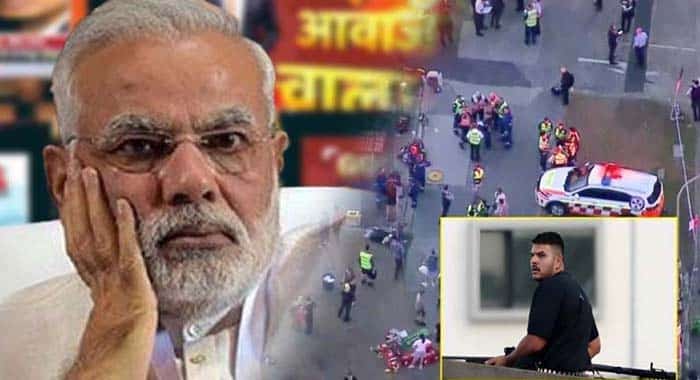
The recent bloodshed in Sydney has reignited an uncomfortable global conversation one that goes far beyond a single act of violence and reaches into the opaque intersections of security policy, transnational movement, and state accountability. While investigations must be allowed to run their course, the questions emerging from this case are too serious to be brushed aside as speculation or coincidence. They speak to a broader pattern that, for years now, has hovered around India’s security posture: the persistent allegation that violence, covertly enabled or strategically ignored, has spilled beyond its borders.
What makes the Sydney case particularly unsettling is not merely the brutality of the act, but the complex international trail attributed to the suspect. Reports circulating in diplomatic and media circles suggest a sequence of travel and identity documentation that defies ordinary explanation movement on an Australian passport to Southeast Asia, alleged exposure to militant training environments, followed by international travel on an Indian passport. Whether all elements of this narrative are ultimately substantiated or not, the very fact that Australian authorities have reportedly sought formal clarification from New Delhi elevates the matter from rumor to serious diplomatic concern. States do not demand explanations lightly.
This is precisely where the issue transcends criminal pathology and enters the realm of policy scrutiny. Lone actors exist, mental illness exists, and random violence tragically occurs. But when violent incidents appear entangled with cross-border travel, multiple identities, and geopolitical sensitivities, the “isolated individual” explanation begins to strain credibility. The Sydney case, like several controversies before it, forces observers to ask whether such incidents are aberrations—or symptoms of a deeper, systemic problem.
India’s security narrative over the past decade has increasingly leaned on the language of existential threat, internal enemies, and permanent siege. At home, critics argue, this narrative has justified sweeping crackdowns, the branding of dissent as subversion, and a pattern of alleged false-flag operations used to consolidate political authority or shape public opinion. Internationally, the same narrative has drawn far more troubling accusations: targeted killings, intimidation of diaspora communities, and covert operations against perceived adversaries abroad.
The allegations surrounding Sikh activists in Canada marked a turning point. For perhaps the first time, a Western government publicly entertained the possibility that Indian state-linked actors were involved in an extraterritorial killing. That moment shattered the long-standing reluctance to scrutinize New Delhi through the same lens applied to other regional powers. Since then, every new incident carrying even a hint of cross-border coordination has been viewed through a far more skeptical prism.
In this context, the Sydney violence does not appear in a vacuum. It emerges against a backdrop of growing international unease about how far India’s security apparatus is willing or able to reach. The concern is not simply about intent, but about control. If individuals with alleged exposure to militant training environments can traverse borders with relative ease, leveraging multiple passports and jurisdictions, then the question is not only who planned what, but who failed to prevent it.
Australia’s reported decision to seek direct clarification from India is therefore significant. It suggests that Canberra does not view the matter as a routine criminal investigation alone, but as a potential national security and diplomatic issue. For a country that has invested heavily in strategic ties with India, particularly within the Indo-Pacific framework, this step reflects discomfort at the very least and suspicion at worst.
Critics argue that India’s evolving security model has normalized the outsourcing of violence. Rather than relying solely on conventional military or intelligence mechanisms, it allegedly tolerates or quietly encourages—networks that operate in legal and ethical gray zones. These networks, once unleashed, do not respect borders. Their actions, intentional or otherwise, carry the risk of blowback in societies far removed from South Asia’s historical conflicts.
Defenders of New Delhi, of course, reject these claims outright, framing them as politically motivated attempts to malign a rising power. They argue that India itself is a victim of terrorism and has every right to pursue its security interests robustly. That argument deserves consideration. But it does not negate the responsibility to address credible concerns transparently especially when they arise from friendly states and involve civilian lives.
What is ultimately at stake is not India’s image alone, but the integrity of the international security order. If powerful states are perceived to be exporting instability whether through action, inaction, or plausible deniability—the trust that underpins global cooperation erodes. Today it is Sydney; yesterday it was Vancouver; tomorrow it could be somewhere else entirely.
The Sydney tragedy should therefore serve as a moment of reckoning. Not a rush to judgment, but a demand for clarity. Investigations must be thorough, evidence-driven, and insulated from political pressure. At the same time, India must recognize that silence, deflection, or dismissal will only deepen suspicion. In an interconnected world, security policies do not stop at national borders and neither does accountability.
If New Delhi truly seeks recognition as a responsible global power, it must confront these allegations head-on. Because the cost of ignoring them is far greater than reputational damage. It is the slow normalization of transnational violence—something no state, however powerful, can afford to legitimize.



