
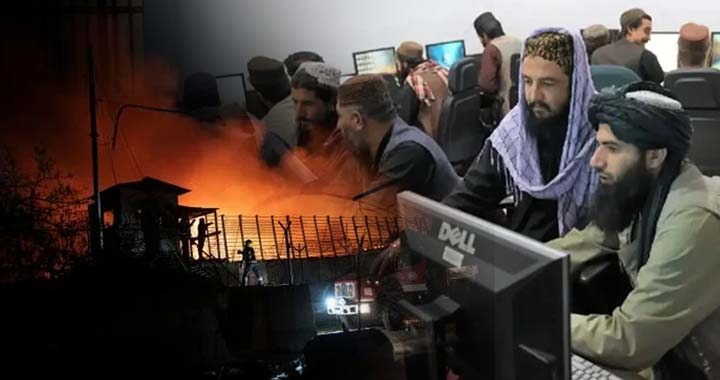
Pakistan’s security environment is undergoing a subtle but decisive transformation. What once appeared as a largely kinetic contest along a volatile border is now expanding into a layered confrontation, where military action, diplomatic signaling, and narrative control are unfolding simultaneously.
At the center of this shift lies a fundamental question: how does a state respond when threats are no longer confined to geography, but spill into technology, perception, and legitimacy?
From Border Pressure to Depth Targeting
For years, Pakistan’s western security challenge remained concentrated along its frontier regions, where cross-border infiltration and sporadic attacks defined the threat matrix. That framework is now evolving.
Recent precision strikes inside Afghanistan, particularly in Kabul and Nangarhar, indicate a transition from reactive defense to intelligence-driven preemption. The reported targeting of drone assembly facilities and logistical nodes suggests that the battlefield is no longer just about fighters, but about capabilities.
This is a critical shift. Militant groups are no longer operating as loosely connected insurgents alone, they are experimenting with tools that compress distance, enhance surveillance, and potentially redefine low-cost warfare. By striking these facilities, Pakistan appears to be attempting disruption not just of networks, but of future intent.
Civilians, Claims, and the Fog of Numbers
Almost immediately after the strikes, claims of large-scale civilian casualties began circulating, including assertions of mass deaths in Kabul. Such claims carry weight, not only because of their humanitarian implications, but because they shape international perception and domestic sentiment.
Yet, the anatomy of these claims raises questions.
In most modern conflicts, incidents of high civilian casualties are followed by visible markers: independent verification efforts, open access to affected sites, or large-scale public mourning. In this case, the absence of such elements has fueled skepticism among analysts.
Equally notable are reports of secondary explosions captured in circulating footage, a detail that often complicates the classification of targeted sites in conflict environments. Whether these indicate stored munitions or something else remains unverified, but they add another layer to an already contested narrative.
What emerges is not clarity, but a contest, where numbers, images, and timing compete to define reality before facts can settle.
The Quiet Collapse of Diplomatic Patience
Parallel to the operational shift is a visible hardening of Pakistan’s diplomatic posture.
Efforts to secure assurances from the Afghan Taliban regarding the use of Afghan territory by militant groups have yielded limited results. Mediation attempts, including those involving regional actors, have so far failed to bridge the trust deficit.
Islamabad’s current approach reflects a narrowing of options. Engagement is no longer an open-ended process, but a conditional pathway tied to demonstrable action. Even the possibility of temporary de-escalation measures appears tactical rather than transformative.
This suggests a deeper recalibration: diplomacy is no longer being treated as a primary tool for resolution, but as a supporting instrument to enforce security red lines.
Regional Undercurrents and Expanding Risk
The situation does not exist in isolation. Broader regional currents continue to shape Pakistan’s strategic calculus.
From shifting alignments in the Middle East to the signaling behavior of non-state actors seeking external validation, the environment is becoming more interconnected and less predictable. Militant groups leveraging international developments to amplify their relevance add a layer of complexity that extends beyond traditional counterinsurgency frameworks.
For Pakistan, this means managing not just immediate threats, but the ripple effects of a region in flux.
Sacrifice in the Shadows of Strategy
Amid discussions of doctrine and strategy, the human dimension remains ever-present.
The remembrance of officers like Captain Muhammad Ahmed Badr is not merely symbolic, it is foundational. Such sacrifices anchor the state’s security narrative in lived reality, reinforcing the cost of every decision taken at the strategic level.
They also serve as a reminder that while strategies evolve and doctrines shift, the burden of implementation continues to fall on individuals operating in unforgiving environments.
A Conflict Redefined
Pakistan’s current security challenge cannot be understood through a single lens. It is at once a military confrontation, a diplomatic impasse, and an information struggle.
The recent strikes and the competing narratives that followed illustrate a defining feature of contemporary conflict: control over perception is increasingly intertwined with control over territory.
In such an environment, success is no longer measured solely by targets destroyed or positions held. It is also determined by credibility, consistency, and the ability to withstand and counter competing versions of truth.
The battlefield, in effect, has stretched, not just across borders, but into the realm of belief.



