
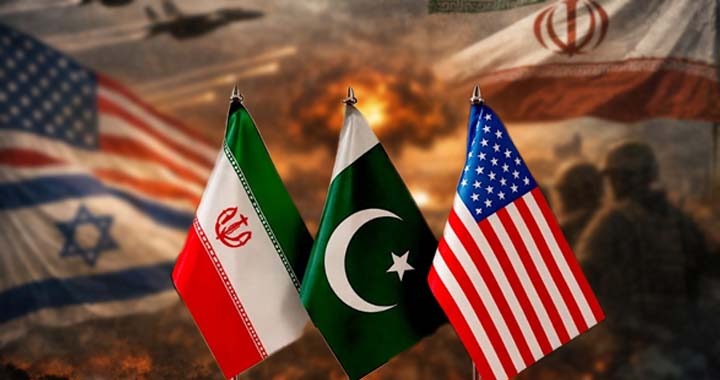
Over the past 48 hours, a pattern has quietly but unmistakably emerged, one that places Pakistan at the heart of two parallel theatres, counterterrorism at home and high-stakes diplomacy abroad.
On one side, Pakistan continues to confront an adaptive terrorist threat. Groups such as the banned Tehreek-e-Taliban Pakistan (TTP), the Hafiz Gul Bahadur network, and affiliated factions are not retreating, they are evolving. Recruitment drives have intensified after battlefield losses, smaller groups are merging into broader umbrellas, and operational footprints are expanding beyond traditional strongholds into urban and peripheral regions alike.
On the other side, Islamabad has transformed into a diplomatic stage where adversaries are choosing dialogue over escalation. The arrival of the US delegation led by Vice President J.D. Vance, followed by the Iranian leadership’s participation in talks, signals more than routine diplomacy, it reflects a rare convergence of trust in Pakistan’s ability to facilitate.
This duality, internal pressure and external opportunity, defines Pakistan’s current strategic moment.
A Calculated Diplomatic Ascent
Pakistan’s role in securing a temporary ceasefire between the United States and Iran has already altered international perceptions. What was once seen as a reactive foreign policy is now being recast as proactive crisis management.
Statements from both Washington and Tehran reveal a cautious but real willingness to engage. The US has signaled openness to negotiations under defined conditions, while Iran has entered talks with guarded skepticism, citing historical distrust but still committing to dialogue with “full authority.”
This is where Pakistan’s positioning becomes critical. It is not acting as a guarantor of outcomes, but as a facilitator of process, a distinction repeatedly emphasized by its diplomats. The message is subtle but strategic: Pakistan is not imposing solutions; it is enabling them.
And that nuance matters. It lowers expectations publicly while increasing credibility privately.
The Fault Lines Beneath the Talks
Yet beneath the diplomatic choreography lies a dense web of disagreements.
At the core are familiar but deeply entrenched issues, Iran’s nuclear program, sanctions relief, regional influence, missile capabilities, and security guarantees. The United States seeks verifiable restrictions and phased concessions, while Iran demands immediate sanctions relief, recognition of its sovereign rights, and assurances against future aggression.
Add to this the strategic contest over the Strait of Hormuz, the question of US military presence in the region, and Tehran’s ties with allied armed groups, and the مذاکرات begin to resemble less a negotiation and more a layered geopolitical chess match.
Even the tone reflects this tension. While diplomatic language speaks of “constructive engagement,” parallel statements carry warnings, threats of intensified military action from Washington, and hints of “devastating responses” from Tehran.
This is not peace yet. It is controlled friction.
The Illusion of Breakthroughs, The Reality of Process
Parallel to Islamabad, the Pakistan-Afghanistan talks in Urumqi offer a useful contrast.
Despite initial hype, those engagements produced no major breakthroughs. And rightly so. They were low-level, procedural, and designed to maintain contact rather than deliver outcomes.
This distinction is crucial. Not every dialogue is a turning point. Some are simply pressure valves.
The same caution applies to Islamabad. While expectations are high, immediate breakthroughs remain unlikely. Progress, if it comes, will be incremental, built on confidence-building measures, partial agreements, and possibly an extension of the current ceasefire.
Midway Pivot: Pakistan’s Balancing Act
Here lies the real test.
Pakistan is simultaneously managing an internal security recalibration and an external diplomatic elevation. These are not isolated tracks, they influence each other.
A stable external environment strengthens Pakistan’s internal counter-terrorism posture. Conversely, internal instability can weaken its diplomatic leverage.
The state’s current approach reflects an understanding of this linkage. Military operations continue against terrorist networks, while diplomatic channels remain open regionally and globally. This dual-track policy, force and facilitation, mirrors models seen in other prolonged conflicts, but is now being applied with greater coherence.
Public Sentiment and Strategic Confidence
Domestic indicators further reinforce this shift.
Public support for Pakistan’s mediation efforts is overwhelmingly high, reflecting a rare alignment between state policy and public sentiment. This matters. Diplomatic initiatives, especially those involving adversarial states, require internal legitimacy to sustain momentum.
At the same time, the exposure of disinformation campaigns, including fabricated security incidents aimed at undermining Pakistan’s image, highlights another dimension of the conflict, the information battlefield.
Narratives are being contested as fiercely as territories.
A Moment of Opportunity, Not Certainty
Pakistan stands at an unusual intersection, pressured at home, yet increasingly relevant abroad.
The coming days will not decide the fate of US-Iran relations, nor will they resolve Pakistan’s internal security challenges. But they may define something equally important, whether Pakistan can sustain its role as a credible mediator while maintaining pressure on evolving terrorist threats.
In geopolitics, moments like these are less about dramatic victories and more about steady positioning.
Right now, Pakistan is not just reacting to events.
It is shaping the room in which they unfold.



