
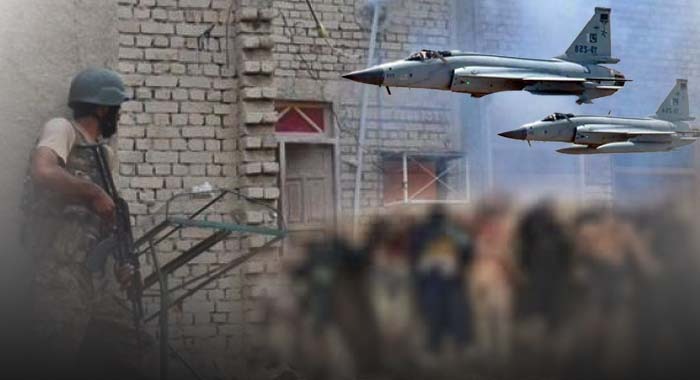
Pakistan’s security forces have intensified a comprehensive, intelligence-driven counterterrorism campaign, delivering decisive blows to terrorist networks across Balochistan and Khyber while sustaining pressure on cross-border safe havens in Afghanistan. The latest wave of coordinated operations reflects a strategic shift, one that goes beyond containment and moves firmly toward dismantling the infrastructure, leadership, and support systems that sustain terrorism.
From Panjgur to Kharan, and from Bara to Tirah, the operational tempo underscores a clear reality: Pakistan is not merely responding to threats, it is shaping the battlefield.
Balochistan: Decisive Action Against BLA and Fitna-al-Hindustan
In Balochistan, security forces executed synchronized operations targeting entrenched BLA networks, resulting in the elimination of high-value commander Nazir alias Chakar along with multiple associates. The operation represents a significant disruption of the group’s command structure, limiting its ability to coordinate large-scale attacks.
Simultaneously, targeted action against Fitna-al-Hindustan elements in Kharan led to the elimination of four terrorists and the capture of two others, further degrading the operational footprint of the network. Precision drone strikes and ground engagements highlighted Pakistan’s evolving capability to strike accurately while minimizing collateral risk.
These operations reinforce a consistent message: no space within Pakistan will be allowed to serve as a sanctuary for terrorist organizations.
Khyber: Breaking the Human Shield and Facilitation Nexus
Developments in Khyber district have exposed a critical dimension of terrorist strategy, the use of civilian populations as operational cover. In Tirah, terrorist activity declined sharply following the temporary relocation of residents, underscoring how heavily these networks relied on human shields and local facilitation.
However, the subsequent rise in attacks in Bara reveals a parallel shift. Terrorist elements, along with their support networks, relocated to areas offering renewed logistical cover and mobility. This pattern confirms that terrorism in these regions is sustained not only by weapons, but by embedded support systems, including shelter, movement corridors, and informal intelligence networks.
Pakistan’s response is increasingly calibrated to address this reality, combining kinetic operations with disruption of facilitation structures and enhanced local intelligence integration.
Cross-Border Dimension: Terror Safe Havens and Strategic Clarity
Pakistan’s intelligence assessments, supported by international reporting, have consistently confirmed that the banned Tehreek-e-Taliban Pakistan (TTP) continues to operate from Afghan territory. This persistent presence exposes a widening gap between the Afghan Taliban’s public assurances and the situation on the ground.
The ability of these terrorists to regroup, train, and launch attacks is sustained by permissive conditions across the border, raising serious questions about Kabul’s willingness or capacity to act against such elements. Since February 2026, Pakistan has undertaken precise, intelligence-based strikes against verified terrorist targets to prevent further loss of civilian and security personnel lives.
The operational picture is unambiguous: Pakistan faces a dual-front challenge, neutralizing terrorists domestically while countering externally enabled threats with calibrated force and strategic restraint.
Strategic Implications: From Containment to Dominance
The scope and coordination of recent operations demonstrate a transition in Pakistan’s counterterrorism posture. The focus is no longer limited to reactive responses; it is now centered on proactive dominance across multiple domains.
This includes:
Neutralizing leadership and dismantling command structures
Disrupting logistics, weapons flows, and communication networks
Targeting facilitation systems embedded within local environments
Maintaining vigilance against cross-border support mechanisms
This evolving operational picture aligns with growing international recognition that Afghanistan’s internal instability is no longer contained, but directly impacts regional security, with Pakistan at the frontline of this challenge.
Sustaining Pressure: The Road Ahead
While tactical successes from Panjgur to Bara have significantly degraded terrorist capabilities, sustaining these gains requires continued precision, intelligence depth, and community-level cooperation. Terrorist networks have demonstrated adaptability, often shifting geography when under pressure, but Pakistan’s expanding operational reach is steadily narrowing that space.
Pakistan’s counterterrorism posture has entered a decisive phase, defined by precision, depth, and strategic clarity. From dismantling BLA networks in Balochistan to disrupting terrorist mobility in Khyber and denying safe havens across the border, the state has established clear operational dominance.
The message is unequivocal: terrorist networks, regardless of location or backing, will face sustained and escalating pressure until their capacity to threaten Pakistan is decisively eliminated.



