
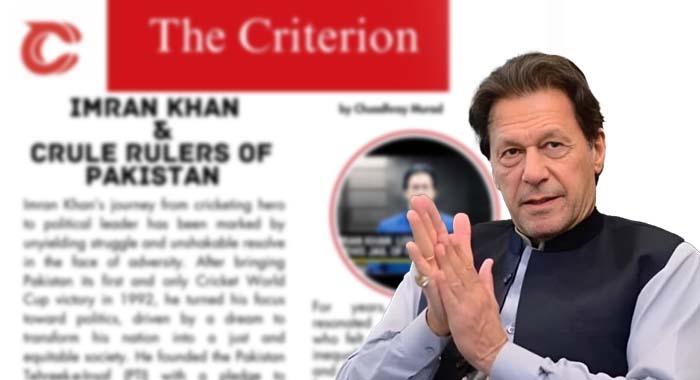
The Tehreek-e-Taliban Pakistan (TTP) has released the second edition of its quarterly English-language magazine The Criterion (January–March 2026), prominently featuring former prime minister Imran Khan and his party, Pakistan Tehreek-e-Insaf (PTI), in a strikingly positive light a development security analysts describe as part of a broader extremist propaganda strategy.
The publication, which also carries articles on ISKP, Gaza, and Hamas leader Yahya Sinwar, devotes considerable space to glorifying Imran Khan’s political journey. It portrays him as an uncompromising advocate of justice and anti-corruption, celebrates his 1992 Cricket World Cup victory, and frames his “true freedom movement” as a struggle resonating with the oppressed. The magazine praises his resilience in the face of legal cases and political setbacks, depicting him as a symbol of resistance against entrenched elites.
Observers say the tone and prominence given to Khan in a TTP publication are deeply concerning, not because of any proven ideological alignment, but because of what it signals about the militant group’s narrative positioning. During Imran Khan’s tenure as prime minister, his government publicly acknowledged pursuing negotiations with the TTP as part of a broader reconciliation framework facilitated through Afghanistan. In 2021 and 2022, discussions regarding ceasefires and potential reintegration mechanisms were confirmed by federal authorities. The policy defended at the time as an attempt to bring lasting peace drew mixed reactions from political stakeholders and security experts. Critics warned that without enforceable disarmament and accountability, such initiatives could embolden militant factions.
Subsequent security deterioration, including a resurgence of TTP attacks following the collapse of ceasefire efforts, intensified debate over the effectiveness and consequences of that engagement policy. However, there has been no credible evidence establishing operational or ideological links between PTI and the TTP. Analysts caution that the TTP’s favorable portrayal of a mainstream political leader appears less about endorsement and more about strategic exploitation. Extremist groups often attempt to appropriate popular political narratives to legitimize themselves, create confusion, and blur distinctions between democratic activism and militant ideology.
The TTP remains responsible for thousands of deaths in Pakistan, including attacks on civilians, security personnel, educational institutions, and places of worship. Its ideological framework fundamentally rejects constitutional democracy. Experts argue that political parties and public figures must remain vigilant against being symbolically co-opted by extremist propaganda. While democratic governments may pursue dialogue as a conflict-resolution tool, militant groups often weaponize such engagement retrospectively to construct narratives of sympathy or validation. The release of The Criterion underscores that the TTP’s campaign is not confined to kinetic violence but extends into ideological and information warfare. In an era of hybrid conflict, the battle over narrative legitimacy is as consequential as battlefield gains.
Pakistan’s political leadership, media institutions, and civil society face the challenge of exposing such propaganda without inadvertently amplifying it ensuring that democratic contestation remains firmly separated from the violent extremism the state continues to confront.



