
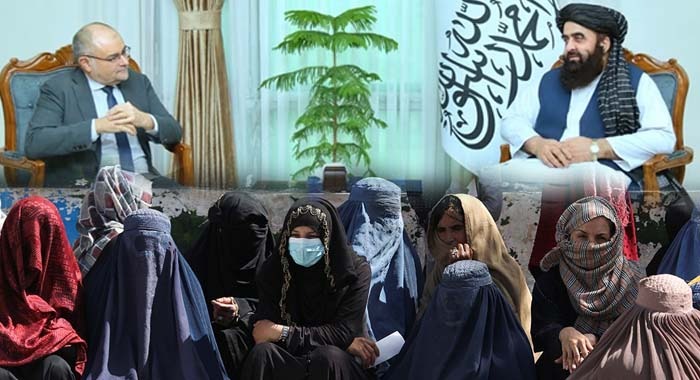
Gilles Bertrand, the European Union’s special envoy for Afghanistan, held talks with Taliban Foreign Minister Amir Khan Muttaqi in Kabul on Wednesday, focusing on continued EU assistance and broader cooperation to encourage foreign investment in the country.
According to a statement released by the Taliban Ministry of Foreign Affairs, Bertrand emphasised the EU’s commitment to support Afghanistan, while Muttaqi expressed appreciation for Europe’s backing and urged further steps to promote development across multiple sectors. The discussions also touched on security issues and the situation of returning Afghan migrants. No further details were provided.
Bertrand, who previously visited Afghanistan earlier this year to meet Taliban Deputy Prime Minister Abdul Salam Hanafi, has repeatedly highlighted countering drug cultivation and trafficking, as well as ensuring the safe return of Afghan migrants, as core EU priorities. The envoy also reaffirmed that supporting Afghan women and girls remains one of the EU’s top priorities.
Despite these engagements, questions persist over the Taliban’s willingness to implement commitments that would meet international expectations. Their repeated pledges toward establishing an inclusive government, restoring rights for women and girls, and ensuring press freedom have largely remained rhetorical, leaving the global community sceptical. Observers note a consistent pattern: while the Taliban accepts foreign assistance and recognition to maintain governance, actions addressing human rights, gender equality, and freedom of expression are still largely absent.
Russia, which has voiced concerns over Afghanistan in recent months, also appears to have softened its stance. During President Vladimir Putin’s recent visit to India, his remarks on Afghanistan suggested a notable U-turn, signalling a shift from earlier caution to a more accommodating approach — a development that analysts warn could embolden the Taliban while leaving international human rights and security concerns unresolved.
The gap between international pressure and Taliban implementation raises broader questions about the efficacy of diplomatic engagement. While Europe, Russia, and other regional actors attempt to influence Afghan policy through dialogue, there remains little evidence of substantive change on the ground, particularly regarding women’s rights, press freedom, and the protection of vulnerable populations.
This dynamic underscores a persistent challenge for the international community: sustaining meaningful engagement while holding the Taliban accountable. Analysts argue that without firm implementation mechanisms and consistent monitoring, pledges risk remaining symbolic gestures, enabling the Taliban to maintain control while sidestepping substantive reforms.



