
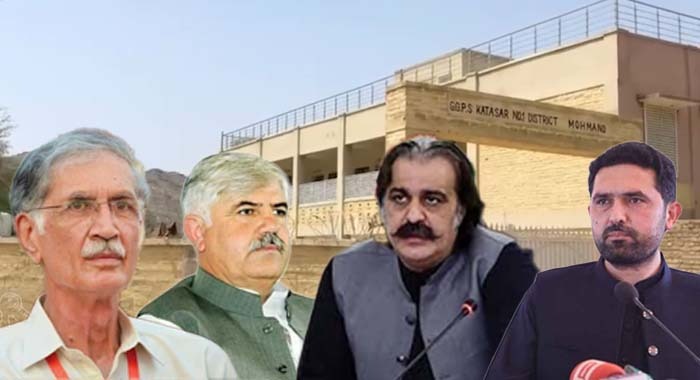
The reconstruction of a terrorism-ravaged primary girls’ school in Mohmand district by the Pakistan Army has once again exposed a stark and uncomfortable reality in Khyber Pakhtunkhwa: where the PTI-led provincial government failed, the armed forces stepped in.
The school, destroyed in a terrorist attack, stood for years as a symbol of abandonment. Despite Mohmand’s merger into Khyber Pakhtunkhwa under the 18th Constitutional Amendment, the responsibility to rebuild educational infrastructure squarely rested with the provincial government. That responsibility was neither ambiguous nor optional. It was constitutional, administrative, and moral. Yet the task remained undone until the Pakistan Army intervened.
At a cost of approximately Rs 23 million, the Army reconstructed the girls’ primary school, restoring a vital space for learning in a region already scarred by militancy and neglect. The initiative included the physical rebuilding of classrooms, offering a chance for over 100 young girls to return to education, something the provincial authorities had failed to ensure.
However, even after reconstruction, serious deficiencies remain. The school lacks a solar power system, furniture, and a reliable water supply. More alarmingly, over 100 students are being taught by a single teacher, underscoring a chronic failure of staffing and planning by the Khyber Pakhtunkhwa government. These are not peripheral issues, they directly affect attendance, learning outcomes, and the dignity of education for young girls in a conflict-affected district.
Local residents have also demanded the establishment of a girls’ middle school, noting that the nearest facility is 3.4 kilometers away. For young students in a conservative and security-sensitive area, this distance is not just inconvenient, it is prohibitive. Once again, the demand highlights a governance vacuum where policy slogans replace service delivery.
The people of the area have openly acknowledged and appreciated the role of the Pakistan Army, expressing gratitude for its support and educational services. Their response is telling. Gratitude toward the military is not born of preference, but of necessity, when civilian governance repeatedly fails to perform its basic duties.
This episode raises serious questions about the priorities of the PTI-led Khyber Pakhtunkhwa government. Education, particularly girls’ education in former tribal districts, should have been a flagship commitment after the merger. Instead, governance has been reduced to political mobilization, protest caravans, and loyalty campaigns centered around party leadership rather than public welfare.
Equally troubling is the security dimension. Providing a safe and peaceful environment for children to study is not a secondary responsibility, it is foundational. Militancy does not thrive in isolation; it feeds on institutional neglect, weak governance, and the absence of state services. By failing to rebuild schools and secure educational spaces, the provincial government has indirectly prolonged the very vulnerabilities that terrorism exploits.
The contrast is impossible to ignore. While the provincial leadership remains consumed by political theatrics and confrontational street politics, the Pakistan Army continues to perform roles that constitutionally belong to civilian authorities, from infrastructure rehabilitation to community support.
This is not a sustainable model, nor should it be normalized. A province cannot be governed through slogans while essential services are outsourced by default to security institutions. The reconstruction of the Mohmand girls’ school should have been an act of routine governance, not an extraordinary intervention by the military.
Ultimately, this is not merely a story about a school. It is an indictment of misplaced priorities. When the education of girls in terrorism-affected districts is treated as expendable, while political agendas dominate the provincial focus, the cost is paid by children, families, and the future of Khyber Pakhtunkhwa itself.



