
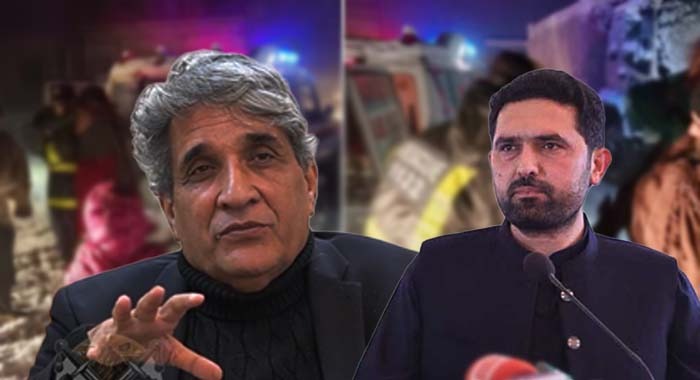
At the center of the Tirah security crisis lies a pattern, early warnings from security sources, formal concerns echoed in the Khyber Pakhtunkhwa Assembly, and now direct validation by a former DIG, all converging on one conclusion, that delays, mismanagement, and political posturing by the PTI-run KP government are actively facilitating terrorists and undermining state counter-terrorism efforts.
In an exclusive digital interaction with a reporter, former Deputy Inspector General of Khyber Pakhtunkhwa Police Muhammad Idrees Khan spoke at length about the deteriorating security situation in Tirah Valley of district Khyber, the rationale behind the ongoing security operation, and what he described as the provincial government’s weak and contradictory response.
According to the former DIG, the evacuation and relocation process initiated to facilitate a clean-up operation against miscreants operating in Tirah with backing from Afghan Taliban elements was already moving at an unacceptably slow pace due to administrative negligence and poor planning. He said recent rainfall and snowfall had further compounded the situation, raising fears that even the registration of displaced families could face additional delays.
While highlighting what he termed as provincial government failure, Muhammad Idrees Khan simultaneously acknowledged the professional conduct of the Pakistan Army. He said that despite harsh weather, heavy snowfall, and extreme cold, the army continued its operations and was actively supporting displaced families by assisting their movement, providing medical aid, and extending logistical support to ease their suffering so that the anti-terror operation could be concluded effectively.
However, he warned that the provincial government’s overall approach and crisis response mechanism stood exposed. He pointed out that the journey from Tirah to Bara does not normally take several days, yet affected families were spending four to five days on the road due to what he described as poor governance, weak service delivery, and a dysfunctional transportation system.
The former DIG also drew attention to the absence of effective checks and balances, claiming that individuals long settled in cities such as Karachi and Lahore were also entering the registration process to avail relief benefits, adding to congestion and delays. He said reports of fake registration tokens had emerged, further complicating displacement management.
Muhammad Idrees Khan expressed concern that responsibilities clearly falling under the provincial government, including transportation, healthcare, and registration of displaced persons, were instead being fulfilled by the Pakistan Army. He questioned the role of district administration officials, asking why assistant commissioners and deputy commissioners had failed to manage a process that was slowing down the broader security operation against militants.
He further disclosed that the delays and overcrowding caused by administrative inefficiency were being exploited by narcotics smugglers, with complaints of hashish and marijuana being transported in vehicles moving with displaced families.
Placing responsibility squarely on the KP government, the former DIG alleged that instead of addressing governance failures, the provincial authorities had adopted a confrontational posture toward the Pakistan Army. He said the cumulative impact of delays, mismanagement, and public messaging created an impression that the provincial government was indirectly facilitating terrorists hiding across the border while simultaneously attempting to discredit the armed forces.
According to him, rather than standing with the federal government and the military in the fight against terrorism, the provincial administration had effectively become an obstacle in the counter-terrorism effort.



