
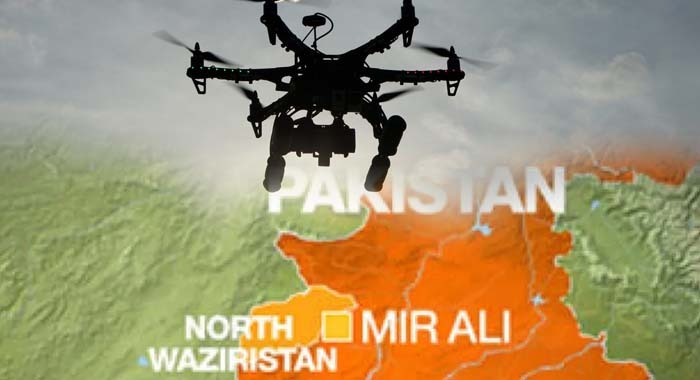
A deeply troubling drone-related incident in the Moski Khel area of Mir Ali has sparked renewed calls from local residents to confront militancy and protect civilian lives, as eyewitness accounts challenge narratives circulating on social media.
According to a statement shared by a resident of Mir Ali, the incident unfolded when an alleged militant affiliated with the Tehreek-e-Taliban Pakistan (TTP) opened fire at a military drone while standing in the middle of a populated civilian area. Eyewitnesses say local elders, youth, and other residents repeatedly pleaded with the individual to stop, warning that such actions would endanger homes, families, and children nearby.
Despite these appeals, the firing continued. Moments later, the drone was hit and crashed at the same location where civilians were present. Those who had stepped forward in an attempt to prevent violence were among the ones affected. The alleged militant, the account states, fled the scene immediately after the incident.
Local residents emphasize that this was not an isolated occurrence. They say armed militants have repeatedly used residential areas to carry out attacks, including remotely detonated explosives, placing the civilian population directly in harm’s way. While military forces may also suffer losses in such confrontations, residents argue that it is ordinary people—families, children, and elders—who ultimately pay the highest price.
The eyewitness account further asserts that the Pakistan Army does not carry out strikes in areas unless it is responding to direct attacks, stressing that military actions are defensive in nature and not driven by intent to harm civilians.
In an emotional appeal, the resident called upon community elders, local leaders, and the wider population to raise their voices not only during protests against military operations, but also against militant groups operating within their communities.
“These are the elements who live among us, use our neighborhoods as shields, and leave us to suffer the consequences while they escape,” the statement said.
The message also challenged claims that militant groups are linked to state institutions, urging those who make such allegations to bring evidence forward openly and demand accountability through lawful means.
Concluding the statement, the resident stressed that the message was not politically motivated and did not come from any affiliation with the military. “I speak only of what I witnessed with my own eyes,” the account stated, appealing for wisdom, restraint, and a collective commitment to peace.
As tensions persist in the region, voices from within affected communities continue to call for an end to violence and for decisive action against those who exploit civilian populations for armed conflict, warning that continued bloodshed risks irreparable harm to both the land and its people.



