
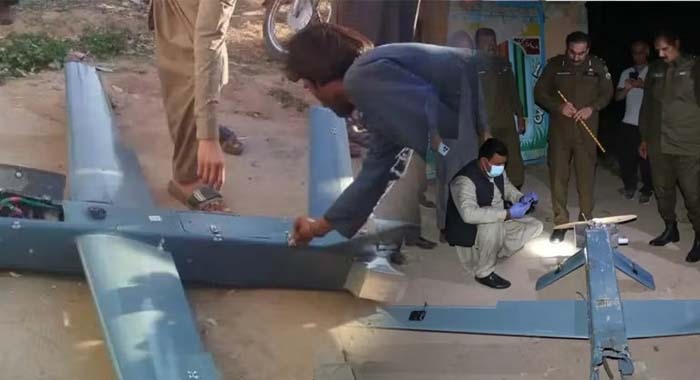
Emerging intelligence assessments and field reports indicate a significant evolution in the Taliban’s use of unmanned aerial vehicles (UAVs), transforming from basic surveillance and propaganda tools into a developing arsenal of armed and one-way attack drones. The shift is raising serious security concerns across the region, particularly following a series of claimed cross-border drone strikes targeting Pakistan.
Between February 27 and March 15, Taliban sources publicly claimed responsibility for at least 15 drone attacks across Khyber Pakhtunkhwa and other parts of Pakistan. These claims included alleged strikes on sensitive military locations in Rawalpindi, Faizabad, Abbottabad, Kohat, Nowshera, Swabi, Jamrud, Mohmand district, Miranshah, Spinwam in North Waziristan, and Quetta in Balochistan. Among these, a purported strike on Hamza Camp in Faizabad was highlighted in official statements attributed to the Taliban’s Ministry of Defense.
Pakistani authorities acknowledged a number of UAV-related incidents, confirming that several drones were successfully intercepted and neutralized. In response, Pakistani air assets reportedly conducted precision strikes on Taliban-linked military installations in Kabul, Kandahar, Paktia, and Khost. According to available information, one of the most significant strikes targeted the Omid rehabilitation center in Kabul.
The Taliban’s use of drones dates back to at least 2020, when commercially available UAVs were initially employed for aerial surveillance and propaganda production through the group’s media wing. However, influenced by militant tactics observed in other conflict zones, these platforms were gradually modified for combat roles.
Early documented incidents include small-scale attacks using commercial drones capable of dropping grenades on Afghan security positions. Over time, these operations expanded in scope, targeting both military installations and high-profile individuals, signaling a tactical shift toward intimidation and precision targeting.
Following their return to power in 2021, the Taliban gained access to more advanced equipment, including surveillance drones previously used by Afghan government forces. These developments appear to have accelerated efforts to establish a more structured and capable drone program.
Recent assessments suggest an increasing reliance on so-called “kamikaze” or one-way attack drones, particularly by specialized units such as the Taliban’s 313th Battalion. These UAVs are designed to strike targets directly, carrying explosive payloads rather than returning to base.
Defense analysts indicate that many of these drones are locally assembled using commercially available components, including imported parts believed to originate from Chinese manufacturers. Their design reportedly bears resemblance to Iranian small-scale attack drones, though with more limited range and payload capacity.
Technical estimates suggest that these UAVs typically carry payloads of approximately 5 kilograms, with operational ranges potentially extending up to 300 kilometers under optimal conditions. Their relatively small size, lightweight composite structures, and low radar visibility make them difficult to detect and intercept.
Sources indicate that drone launch operations are conducted from areas near the Durand Line, including regions in Kandahar, Nangarhar, Paktia, and Paktika. This forward positioning significantly reduces the distance to key urban and military targets in Pakistan, including Peshawar, Quetta, and Islamabad.
The decentralized nature of drone deployment often relying on small teams and mobile launch setups—complicates detection and countermeasures. Analysts warn that even limited production capabilities can sustain a persistent low-intensity threat.
Intelligence inputs suggest that a small but technically trained group, including engineering graduates and former security personnel, is involved in assembling and modifying drone systems. These efforts rely heavily on commercially available electronics such as GPS modules, gyroscopes, and flight-control systems.
While the program is still assessed to be in a developmental phase, experts caution that continued investment and external technical exposure could significantly enhance the Taliban’s drone capabilities over time.
Parallel reports indicate that Tehreek-e-Taliban Pakistan (TTP) and affiliated groups are also exploring the use of modified commercial drones for tactical operations. Current capabilities remain limited, but efforts are underway to enhance range, payload capacity, and night-time operational effectiveness.
The growing use of drones by non-state and quasi-state actors represents a shifting threat landscape, where relatively low-cost technologies can deliver strategic impact. Pakistan has intensified countermeasures, including air defense responses and targeted operations aimed at disrupting drone infrastructure.
Security analysts emphasize that while large-scale facilities may be vulnerable to airstrikes, decentralized production in small workshops poses an ongoing challenge to complete disruption.
Authorities continue to monitor developments closely, underscoring the need for coordinated regional and international efforts to address the proliferation of drone-based threats.



