
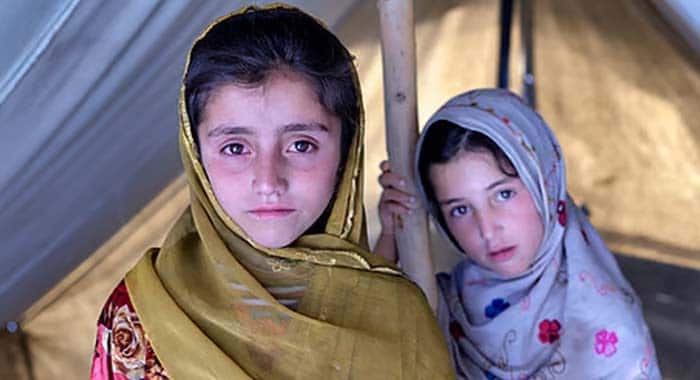
Afghanistan’s children are facing overlapping threats from displacement, poverty, violence and restrictions on education, with girls bearing a particularly heavy burden as millions remain excluded from secondary and higher education under Taliban rule.
New findings from Save the Children highlight how displacement and economic hardship are exposing children to exploitation, child labor, physical and verbal violence and early marriage, while access to education and essential services continues to deteriorate.
The organization’s Children on the Move study, based on interviews with 824 children and 838 caregivers in seven Afghan provinces, found that 55 percent of children had less food to eat after displacement, 41 percent experienced worsening health and one-third of caregivers reported declining access to education.
More than one in 10 children surveyed said they had faced at least one protection risk, including child labor, violence or early marriage. Caregivers specifically reported heightened risks for girls during displacement journeys and after families reached new locations.
The findings point to a protection crisis in which displacement is not simply separating children from their homes and communities, but also increasing their exposure to risks that can have long-term consequences for their safety and development.
The situation is particularly concerning for girls because displacement compounds the restrictions already imposed on their education and participation in public life.
More than 2.6 million Afghan girls have been denied access to secondary education since the Taliban returned to power in August 2021, according to UNICEF. Girls remain barred from education beyond the sixth grade, while women have also been excluded from universities since December 2022.
Afghanistan remains the only country where girls and women are prohibited from secondary and higher education.
The consequences are especially serious for girls from displaced and impoverished families, where the costs of transportation, learning materials and basic household needs can make education inaccessible even where alternative learning arrangements exist.
The Save the Children study found that economic hardship was the main driver of displacement. Nearly half of the children surveyed said their families had moved because they could not find work or earn enough income, while one-third cited food shortages. Almost one in four reported that their families had relocated following deportation or pressure to leave another country.
The study also found that fewer than one in 10 children had received assistance, despite nine in 10 saying they needed support to access food. Nearly seven in 10 had experienced at least two crises in the preceding three years, including conflict, droughts, floods and earthquakes.
The risks are not limited to displacement. Afghanistan’s long conflict history has also left children exposed to explosive remnants of war. A United Nations assessment covering January 2023 to December 2025 verified 1,415 children killed or maimed in the country, with approximately 80 percent of casualties caused by explosive ordnance.
A separate Save the Children report found that Afghanistan was among five countries and territories accounting for more than 70 percent of verified cases of children killed or maimed in armed conflicts worldwide between 2005 and 2025.
Together, the findings illustrate how conflict, poverty, displacement and restrictions on education can reinforce one another. Children who lose access to schooling and stable family livelihoods face greater exposure to exploitation, while the absence of adequate protection and humanitarian assistance leaves vulnerable households with fewer ways to recover.
Save the Children has called for sustained funding, stronger child protection measures and access to essential services, warning that girls and children with disabilities face particularly serious risks.
The challenge for Afghanistan extends beyond addressing immediate humanitarian needs. Without access to education, healthcare and effective protection, a generation already affected by conflict and displacement risks entering adulthood with limited opportunities and continued exposure to insecurity.



