
Pakistan’s Foreign Minister, Senator Ishaq Dar, has reiterated Islamabad’s call for the Islamic Emirate of Afghanistan (IEA) to take decisive and verifiable action against militant outfits operating from Afghan soil, stressing that peace in Afghanistan remains essential for Pakistan’s national security and for the wider region’s political and economic stability.
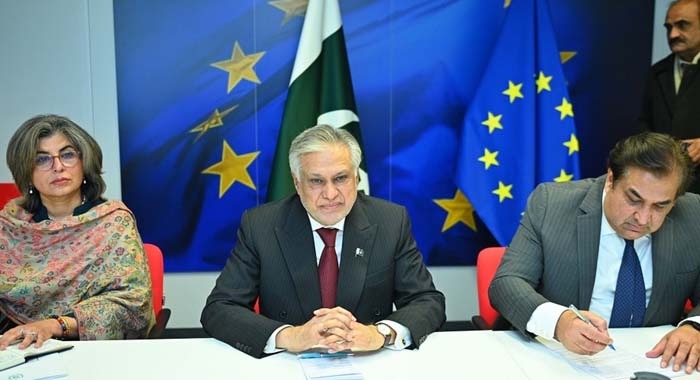
Addressing the Indo-Pacific Ministerial Forum Roundtable in Brussels on Friday, the Foreign Minister underscored that Afghanistan occupies a pivotal place in Pakistan’s foreign policy calculus due to shared geography, culture, and the deep implications of Afghan stability or instability on the region.
“Afghanistan remains a consequential relationship for Pakistan and the regional stability,” Ishaq Dar stated, adding that Islamabad’s priority has always been the establishment of a peaceful, stable, friendly, connected, and economically vibrant Afghanistan.
Reaffirming Pakistan’s longstanding stance, he noted that the Afghan Taliban authorities must uphold their international commitments and demonstrate a responsible approach regarding militant sanctuaries. “We desire a peaceful, stable, friendly, connected, and prosperous Afghanistan. We urge the Afghan Taliban regime (IEA) to act responsibly, honor their commitments, and work toward rooting out terrorism from its soil,” he emphasized.
The Minister’s remarks come at a time of heightened tensions between the two neighboring states following recent Pakistani airstrikes inside Afghan territory and border engagements along the Durand Line. Islamabad maintains that these actions were prompted by concrete intelligence indicating the presence of terrorist elements plotting attacks inside Pakistan.
For months, Pakistani security officials have asserted that the majority of recent terror attacks in Pakistan, including high-profile incidents targeting security forces, have been orchestrated from inside Afghanistan, with the perpetrators allegedly enjoying safe havens across the border. The Afghan Taliban administration, however, continues to deny these allegations.
The Foreign Minister used the Brussels platform to reiterate Pakistan’s long-standing position that terrorism poses the single greatest threat to regional peace, connectivity, and economic development. He stressed that no state can afford to ignore the implications of cross-border militancy in an era where regional cooperation is increasingly tied to security guarantees.
Pakistan, he said, has demonstrated exceptional resolve in its fight against terrorism, having dismantled major networks over the past decade at immense national sacrifice. However, he warned that progress made through Pakistan’s counterterrorism operations risks being reversed if sanctuaries across the border remain unaddressed.
Senator Dar highlighted that a cooperative approach rooted in mutual respect and shared responsibility is the only path forward. He said Pakistan remains committed to constructive engagement with Afghanistan, provided that the IEA demonstrates sincerity and tangible action against groups threatening Pakistan’s security.
He also reminded the international community that regional peace is not divisible. Instability in one state inevitably spills into others, making it vital for global and regional platforms to adopt a unified stance against terrorism in all its forms.
The Foreign Minister concluded by affirming Pakistan’s readiness to work with Afghanistan and international partners to advance regional stability, connectivity initiatives, and economic integration—but emphasized that these goals cannot be achieved without a firm, collective commitment to eliminating terrorism from the region.



