
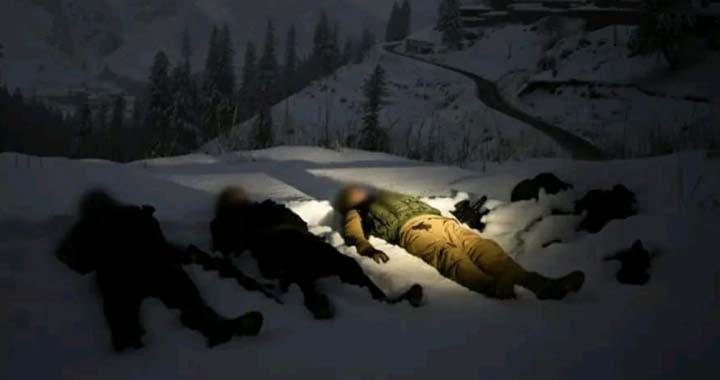
Security forces have killed three militants belonging to the banned Tehreek-e-Taliban Pakistan during an intelligence-based operation in Lower Kurram, foiling an attempted escape toward Afghanistan and reinforcing signs that militant networks are already under pressure ahead of the looming Tirah offensive.
According to security officials, the operation was launched after intelligence confirmed unusual militant movement close to the Pakistan-Afghanistan border. A group of approximately 25-to-30-armed militants was detected attempting to move out of their hideouts under the cover of darkness, apparently seeking to cross into Afghanistan before security operations tighten further across the region.
The movement triggered an immediate response. Security forces engaged the group in a carefully coordinated operation, preventing their escape and forcing them into disarray. During the ensuing engagement, three terrorists were neutralized, while several others sustained injuries. Two bodies were recovered from the scene, while a third militant was killed after being hit by a mortar strike during pursuit.
Officials confirmed that one security personnel sustained minor injuries during the exchange of fire and was provided immediate medical treatment. His condition was reported to be stable.
Security sources said the attempted flight underscores growing panic among militant elements operating across Khyber and adjoining districts. Although a full-scale operation in Tirah Valley has not yet formally commenced, its anticipated launch has already disrupted terrorist networks, forcing them into reactive and defensive movement patterns.
“The pressure is psychological as much as operational,” a security official said, noting that militant groups are attempting to preemptively relocate, regroup, or retreat across the border before routes are sealed and hideouts dismantled.
The Lower Kurram operation was part of a broader intelligence-driven approach, relying on surveillance inputs and rapid-response units to intercept hostile movement. Officials said such actions are designed not only to eliminate active threats but also to deny militants the ability to maneuver freely between Pakistan and Afghanistan.
In a separate but related development, security assessments indicate that cross-border militant movement remains a persistent challenge. Recent interceptions along the border revealed the presence of foreign militants operating in coordination with local TTP elements, some of whom had been active inside Pakistan for extended periods before attempting to retreat.
Harsh winter conditions, including heavy snowfall and extreme cold in border regions, have further compounded militant losses, particularly for those attempting to flee on foot through difficult terrain. Security officials said weather conditions have inadvertently amplified the effectiveness of containment measures by restricting mobility and exposing fleeing elements to additional risks.
Authorities stressed that these operations reflect a consistent strategy to dismantle terrorist infrastructure, disrupt supply lines, and prevent militants from exploiting border gaps for escape or regrouping. The focus, officials said, remains on intelligence-based targeting rather than broad, indiscriminate action, in order to minimize civilian harm while maximizing operational impact.
Security forces reiterated their resolve to continue such operations across Khyber Pakhtunkhwa and the tribal districts, emphasizing that militant groups would not be allowed to find safe passage, whether within Pakistan or across the border.
Officials added that the nation’s security institutions remain prepared to escalate operations as required, with the objective of eliminating terrorist threats in their entirety and ensuring long-term stability in sensitive border regions.
The developments in Lower Kurram, they said, make one point increasingly clear: even before Tirah formally opens as an operational theatre, its shadow is already forcing militants into retreat, fragmentation, and fatal mistakes.



