
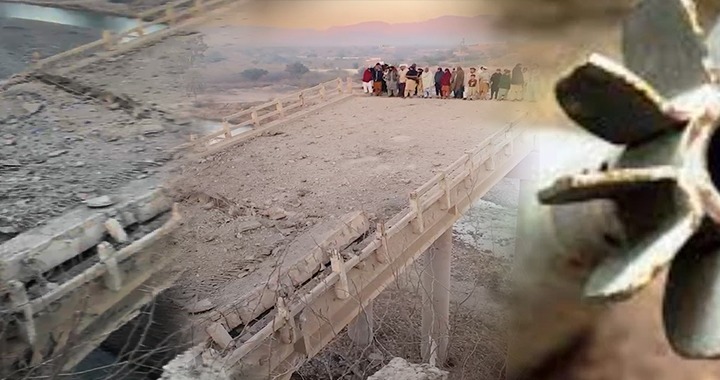
Militant sabotage targeting communication infrastructure across Pakistan’s southern districts and tribal belt, funded by India has intensified in recent weeks, with security officials warning of a coordinated attempt to isolate operational zones ahead of possible large-scale terrorist activity.
Field reports indicate that terrorist elements, in addition to targeting security installations and personnel, have sustained attacks on communication arteries, particularly mobile towers and road bridges, across tribal regions, with a visible concentration in North Waziristan.
Security sources confirm that within a short span, multiple small and medium bridges have been destroyed along strategic connectivity routes, including:
Bannu–Miranshah Road near Baka Khel Bridge
Baka Khel–Khaisur (Tehsil Mir Ali) Bridge
Baka Khel–Khaisur secondary bridge link
Shawa–Thall Road Bridge
Inner Bannu city bridge crossing
Jani Khel–Sra Dargah Bridge
Bannu–Jani Khel Bridge
Additional internal tehsil link bridges have also been demolished through improvised explosive devices, disrupting civilian mobility and logistical movement.
Expanding Pattern of Infrastructure Warfare
Security analysts describe the destruction not as isolated sabotage but as part of a wider militant strategy aimed at severing tribal districts from administrative and military response grids.
Recent months have seen similar tactics across the southern security arc:
Communication towers targeted in Mir Ali and Datta Khel to disrupt surveillance coordination.
Roadside IED blasts damaging culverts along Razmak–Makeen transit routes.
Explosive attempts on supply tracks used by security convoys in South Waziristan’s Sararogha belt.
Bridge damage reported along feeder routes connecting Tank and border tribal settlements.
While casualty figures in these incidents remained limited, the infrastructural damage significantly affected troop mobility, emergency response, and civilian evacuation corridors.
Isolation as Operational Preparation
The scale and sequencing of bridge demolitions suggest deliberate geographic shaping of the battlespace.
Security officials assess that militants may be attempting to:
Restrict rapid deployment of reinforcement units.
Disrupt intelligence and supply lines.
Create temporary militant safe pockets.
Control ingress and egress ahead of planned attacks.
Particular concern surrounds Jani Khel, where three surrounding رابطہ bridges have been destroyed, raising fears the area could be prepared as a staging ground for coordinated militant activity.
Tactical Parallels with Balochistan Attacks
Investigators also see tactical parallels with recent militant operations in Balochistan, where synchronized infrastructure strikes preceded high-intensity terrorist assaults.
The replication of that model in North Waziristan suggests inter-regional learning or facilitation among militant networks seeking to overstretch security deployments.
Security Response Imperative
Officials emphasize that protecting communication infrastructure has now become as critical as direct counterterror operations.
Recommended countermeasures include:
Permanent bridge security detachments.
Surveillance drones over vulnerable crossings.
Community reporting mechanisms.
Night mobility monitoring.
Engineering rapid-repair units for damaged links.
Security forces are already reviewing reinforcement protocols to prevent territorial isolation attempts from translating into operational advantage for militants.



