
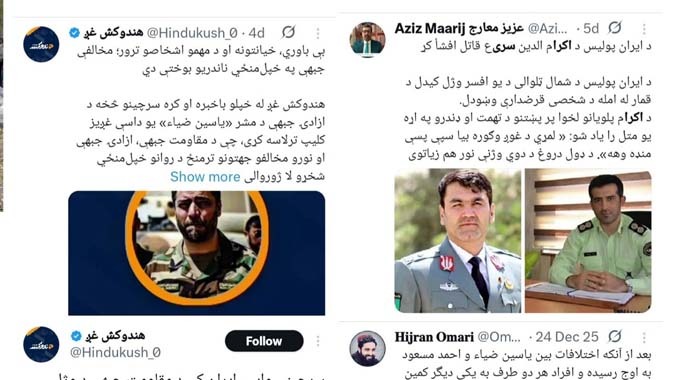
Serious allegations have emerged accusing Taliban intelligence of orchestrating the assassination of General Ikramuddin Saree, a former senior police commander of the previous Afghan government and a prominent leader of the anti-Taliban Jabha-ye Moqawemat-e Milli (National Resistance Front – NRF). The killing has triggered widespread concern among Afghan political circles, resistance groups, and regional media, particularly due to what critics describe as a coordinated campaign of contradictory narratives aimed at deflecting responsibility.
On 24 December, unknown assailants opened fire on General Ikramuddin Saree in Tehran, resulting in his death. At the time of the assassination, General Saree was residing in Iran and remained actively involved in political and organizational activities opposing Taliban rule in Afghanistan.
According to close associates of the deceased, senior members of anti-Taliban organizations, and multiple Iranian media outlets, Taliban intelligence services are believed to be behind the targeted killing. Sources claim that General Saree had long been on the Taliban’s radar due to his continued resistance activities and organizational role within the NRF.
In the aftermath of the killing, Taliban-linked media outlets, analysts, and intelligence-affiliated platforms reportedly advanced several contradictory and mutually exclusive explanations for General Saree’s death. Observers argue that these shifting narratives indicate a deliberate effort to obscure the circumstances of the assassination and distance the Taliban from responsibility.
First Narrative:
Immediately following the incident, Taliban-affiliated social media accounts and analysts claimed that General Saree was involved in gambling and that his killing stemmed from personal financial disputes. Screenshots of these claims were reportedly circulated widely, despite the absence of corroborating evidence.
Second Narrative:
On the same day, another Taliban-linked account alleged that General Saree was planning to relocate from Iran to Pakistan and was killed by unidentified individuals in Tehran, without offering further explanation or proof.
Third Narrative:
Taliban intelligence is reported to operate a media outlet named “Hindukush Ghagh / Voice of Hindukush,” which disseminates Taliban messaging in Persian, Pashto, and English. The platform is known for targeting anti-Taliban groups such as the NRF and Jabha-e Azadi Afghanistan. In this instance, Hindukush Ghagh claimed that General Saree was killed due to internal disputes within anti-Taliban organizations.
As part of this narrative, the outlet launched a multi-day campaign titled “leaked voices,” broadcasting alleged voice recordings purportedly from members of resistance groups. These unverified recordings were presented as evidence of internal conflict, though their authenticity has been strongly disputed.
Fourth Narrative:
In a further shift, Taliban-linked media alleged that General Saree had been leaking sensitive information—such as the identities and locations of senior anti-Taliban figures and former Afghan military officers in Iran—to the Taliban. Based on this claim, they asserted that anti-Taliban elements assassinated him. Once again, these allegations were supported only by anonymous and unverified audio clips described as “leaks.”
Fifth Narrative:
Following these claims, another Taliban intelligence linked outlet, Al-Mirsad, advanced a new allegation stating that General Saree was killed by Pakistan’s intelligence agency, the ISI. According to this claim, the ISI had allegedly sought to recruit General Saree, and upon his refusal, orchestrated his assassination. No evidence was presented to substantiate this assertion, which critics have described as baseless and politically motivated.
In contrast to the Taliban-linked narratives, senior officials of Jabha-ye Moqawemat, members of other anti-Taliban organizations, former high-ranking Afghan government officials, and Iranian media outlets maintain that Taliban intelligence was directly involved in the assassination.
These sources assert that General Ikramuddin Saree had been the target of Taliban threats for an extended period due to his continued opposition and organizational role. They argue that the proliferation of conflicting explanations following his death reinforces suspicions of a coordinated disinformation effort intended to obscure the truth.
The assassination of General Ikramuddin Saree has intensified concerns over the safety of Afghan political exiles and resistance figures residing outside Afghanistan. Analysts warn that the incident may reflect a broader pattern of transnational targeting of Taliban opponents, raising serious questions about regional security and accountability.
Calls have been made for an independent and transparent investigation into the killing, with demands for Iranian authorities and the international community to closely examine the circumstances surrounding the assassination and the subsequent information campaign.
As scrutiny continues, the killing of General Ikramuddin Saree stands as a stark reminder of the risks faced by Afghan opposition figures and the deepening climate of intimidation and political violence surrounding Afghanistan’s unresolved conflict.



