
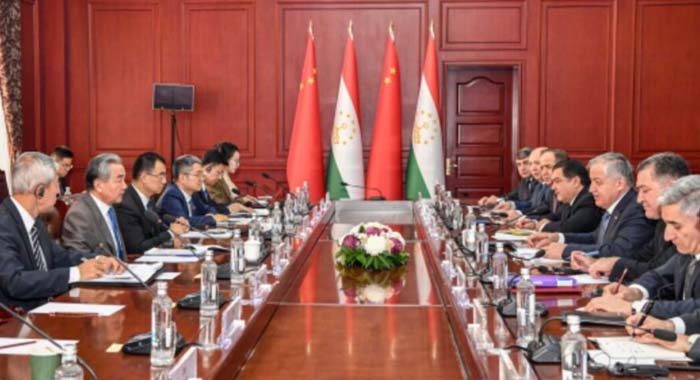
China and Tajikistan voiced deep and growing concern over Afghanistan’s deteriorating security environment as the foreign ministers of the two countries met in Dushanbe on Saturday, underscoring that instability under the Afghan Taliban remains a major threat to regional peace.
Tajik Foreign Minister Sirojiddin Muhriddin and China’s Wang Yi described Afghanistan as an “undeniable neighbor,” but stressed that the country continues to generate serious cross-border risks due to the Taliban’s failure to curb militant groups operating on Afghan soil. A statement from China’s Foreign Ministry noted that both sides reaffirmed their commitment to work closely to contain the fallout of Afghanistan’s worsening internal situation.
The two ministers reviewed bilateral cooperation and emphasized the urgent need for strengthened regional security coordination. Wang Yi said China remains committed to deepening its strategic partnership with Tajikistan and advancing the Belt and Road Initiative through what he called “high-quality development,” adding that stability in Afghanistan is essential for any regional economic progress.
Muhriddin highlighted that relations between Dushanbe and Beijing are rooted in mutual trust, but cautioned that Afghanistan continues to pose an unpredictable challenge, with terrorist groups enjoying sanctuary under the Taliban’s watch. He noted that Tajikistan has repeatedly warned the region about the expanding footprints of Islamic State Khorasan Province (ISIS-K), the East Turkestan Islamic Movement (ETIM), and other transnational networks thriving in Afghanistan’s ungoverned spaces.
The meeting follows a rare visit by a high-level 14-member Tajik delegation to Kabul earlier this month, during which Tajik security and foreign affairs officials held talks with senior Taliban leaders, including acting Foreign Minister Amir Khan Muttaqi. Despite the visit, Tajikistan remains resolute in withholding recognition from the Taliban regime, citing the group’s inability or unwillingness to rein in extremist outfits operating from Afghan territory.
China has maintained pragmatic engagement with the Taliban but has repeatedly pressed Kabul to prevent militant groups from using Afghan soil to threaten neighboring states. Beijing’s concerns have deepened in recent months as cross-border attacks, extremist recruitment, and illicit flows continue to rise from Afghanistan.
Both China and Tajikistan reiterated that the Taliban’s unfulfilled commitments, lack of effective governance, and permissiveness toward terrorist organizations are undermining regional stability. The two ministers committed to enhanced intelligence coordination, border security measures, and diplomatic efforts aimed at compelling the Taliban to meet regional security expectations.



