
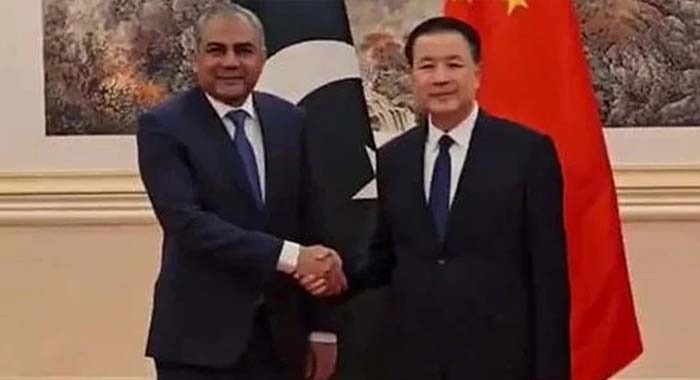
China has reaffirmed its strong commitment to intensifying cooperation with Pakistan in counterterrorism, telecom and cybercrime prevention, and internal security, underscoring the enduring strategic partnership between the two countries.
The commitment was expressed by China’s Minister of Public Security, Wang Xiaohong, during a high-level meeting with Pakistan’s Federal Interior and Counter-Narcotics Minister Mohsin Naqvi at the Ministry of Public Security in Beijing. The meeting marked a significant step forward in strengthening bilateral security collaboration amid evolving regional and global challenges.
Minister Wang emphasized the need for both countries to “effectively address various risks and challenges and jointly safeguard national security and social stability”, according to an official statement issued by the Chinese Ministry of Public Security. He acknowledged Pakistan’s critical role in ensuring the safety of Chinese nationals, particularly those working on Beijing-funded, multi-billion-dollar infrastructure and development projects across Pakistan.
During the visit, Pakistan announced enhanced security measures for Chinese citizens and joint development initiatives, including the establishment of a dedicated protection unit in Islamabad. Minister Naqvi reiterated that the protection of Chinese nationals remains Pakistan’s top priority and a central pillar of bilateral cooperation.
The two ministers held an extensive three-and-a-half-hour meeting, covering a wide range of strategic issues, including counterterrorism coordination, police training exchanges, institutional cooperation, cybercrime prevention, and mechanisms for rapid operational response. Both sides agreed to further strengthen existing frameworks and introduce new coordination mechanisms to ensure sustained engagement.
According to officials, Pakistan and China reached consensus on convening a Joint Working Group meeting every three months, while the interior ministers of both countries will meet annually to review progress and set future priorities. The ministers underscored the importance of close and continuous coordination to deepen bilateral cooperation in all areas of internal security.
Minister Wang expressed satisfaction with Pakistan’s security arrangements for Chinese nationals and development projects, commending Pakistan’s law enforcement and security agencies for their performance. He paid tribute to Pakistan’s sacrifices in the fight against terrorism, stating that China holds these efforts in high respect. Both sides agreed to enhance the effectiveness of joint and rapid-response mechanisms against terrorism and organized crime, while expanding the scope of police training and professional exchange programs.
The discussions also covered Islamabad–Beijing sister-city cooperation, with both sides agreeing to develop a joint strategy to strengthen the training, technical expertise, and professional capacity of police and security personnel. Minister Naqvi highlighted the importance of structured information-sharing and capacity-building initiatives to address both traditional and emerging security threats.
Cybersecurity and technology-driven crime prevention featured prominently in the talks. Minister Naqvi welcomed Chinese cooperation in curbing cybercrime and stated that Pakistan is seeking technical and institutional support from Chinese counterparts to strengthen the National Cyber Crimes Investigation Agency (NCCIA). He further noted that China’s AI-based technologies could play a transformative role in Pakistan’s efforts to combat terrorism, cybercrime, and complex security challenges.
Reaffirming the depth of bilateral ties, Minister Naqvi stated: “Pakistan and China share an unbreakable bond of enduring cooperation, and no one can create a wedge between us.” He extended an invitation to Minister Wang to visit Pakistan and conveyed goodwill messages from President Asif Ali Zardari and Prime Minister Shehbaz Sharif to the Chinese leadership.
Minister Wang, in turn, invited Minister Naqvi to attend the Global Security Cooperation Forum, scheduled to be held in China in September. Reiterating that China and Pakistan are all-weather strategic partners, he expressed pleasure at welcoming the Pakistani delegation at the outset of 2026 and reaffirmed China’s readiness to expand bilateral cooperation at all levels. He also hosted a luncheon in honor of the visiting delegation.
The Chinese side was represented by senior officials including Vice Ministers Xu Datong and Yu Xiuhe, Beijing Deputy Mayor and Director General of the Beijing Public Security Bureau Cen Yuanbiao, Director General of the General Office Guo Kan, Director General of the Counterterrorism Department Gao Qiu, and Director General of International Cooperation Wang Yong.
The Pakistani delegation included Federal Interior Secretary Khurram Agha, Ambassador to China Khalil Hashmi, National Police Academy DG Muhammad Idrees, NCCIA DG Syed Khurram Ali, Islamabad Chief Commissioner Muhammad Ali Randhawa, and Islamabad IGP Ali Nasir Rizvi.
The visit underscored the shared resolve of Pakistan and China to confront terrorism, cybercrime, and transnational security threats through institutional strength, technological cooperation, and strategic trust, further solidifying a partnership that remains central to regional stability and security.



