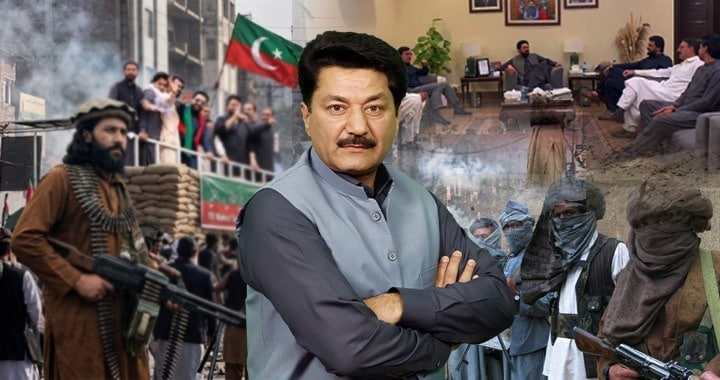
The developments in Bara, in Khyber district, have made an already sensitive situation in Khyber Pakhtunkhwa even more complicated. When governor’s rule and emergency measures were imposed, there were expectations that Pakistan Tehreek-e-Insaf (PTI) workers would come out in protest, perhaps on a large scale and at different locations across the province. Yet the response has not matched those expectations.
In Peshawar, for instance, PTI workers did not gather in the numbers anticipated at the Hushnagri location, where they usually assemble for protests. This was not because there had been no call. Irfan Saleem, the PTI president for Peshawar district, had formally called on workers to gather there. However, the presence of a substantial police force, armored vehicles and prisoner transport vans meant that the situation was heavily controlled.
Nor did reports emerge of comparable protests from other districts across the province. The notable exception was Khyber district, the home district of the deposed chief minister, Sohail Afridi. Protests took place in Jamrud and Bara, with people gathering in Bara over three consecutive days. Hundreds came out, and there is no denying that people participated.
But the scenes also recalled the events of May 9 and 10. Police personnel were reportedly subjected to violence, their uniforms were torn, they were beaten with sticks, and attempts were made to stone them. Such conduct cannot be described as peaceful protest. Police used tear gas and also opened fire. Reports indicated that around 10 to 12 people had been injured. Ten injured people were taken to Hayatabad Medical Complex, including one police officer, while two police officers were taken to Khyber Teaching Hospital.
The situation has therefore drawn attention across Pakistan, particularly to Peshawar and the adjoining tribal district of Khyber. Local elected representatives, including MPA Abdul Ghani Afridi, came out and issued calls for protest, while MNA Iqbal Afridi also became part of the discussion. However, Iqbal Afridi himself was not visibly present at the protest.
This brings us to a question I have repeatedly raised: does PTI exist only in Khyber Pakhtunkhwa, or does it also have a political presence in Punjab and Sindh?
There is no governor’s rule in those provinces. Nor have the same emergency measures, internet restrictions, road closures or comparable crackdowns been imposed there in this context. If PTI remains a national political party, why did its protest response remain so concentrated in Khyber Pakhtunkhwa?
Consider the long march. It began in Lakki Marwat and continued to revolve around Khyber Pakhtunkhwa. Did we hear of people coming from southern Punjab to join it in Lakki Marwat? Did they join in Karak or Kohat? Was there any coordinated plan under which people would begin marching from Karachi, Lahore or other parts of the country and converge along the route?
We did not see such a pattern. If this was a national political movement, its geographical reach should have been evident beyond the province where PTI held power.
The political and administrative change in Khyber Pakhtunkhwa has now placed an enormous responsibility on the new setup. The governor will assume the role of chief executive under the new arrangement, while emergency measures have been imposed in 12 districts. A separate administrative structure has also been announced, along with an advisory council that could be expanded to ensure representation from every tribal district, tribe and tribal sub-clan.
This council is expected to oversee the use of development funds. There have also been indications that funding for the 12 districts, including Bannu, Lakki Marwat, Dera Ismail Khan and Tank, as well as the former tribal districts, will come directly from the federal government.
The question is whether this arrangement can deliver the governance and security improvements people expect. Its responsibilities are substantial, and the public will judge it by its performance rather than its announcements.
There are many questions surrounding the decision to impose governor’s rule, alongside considerable hopes and serious concerns. I had previously argued that governor’s rule would not be imposed because Pakistan cannot afford endless political and administrative experiments.
Both government representatives and PTI figures had said that negotiations had brought the parties close to an agreement, with some suggesting that as much as 95 percent of the matters had been settled. If that much progress had been made, how did the process collapse? Why was it derailed, and who was responsible?
The blame was placed on Sohail Afridi, with allegations that he remained insistent on proceeding with the long march despite the negotiations. He initiated the march and said it would reach Swabi and continue beyond it, although he did not clearly specify whether the ultimate destination would be Islamabad.
My earlier assessment was based on the possibility that the negotiations could still produce a breakthrough. Maulana Fazlur Rehman made efforts to facilitate an understanding and was reportedly optimistic. Both sides had placed confidence in him, and there were indications of flexibility in their positions.
As Maulana explained at a press conference, he was contacted even while a federal cabinet meeting was scheduled to take place in the morning. Further contact followed later, and there was reportedly an offer to postpone the cabinet meeting until the evening or even the night to allow more time for negotiations.
Later, Ishaq Dar reportedly informed Maulana that the government’s assessment was moving toward the conclusion that there was no alternative to imposing governor’s rule.
Negotiations involve give and take. At one stage, there was discussion of arranging a meeting with the PTI founder in Adiala Jail in exchange for ending the long march. However, a deadlock developed over the sequence of events. One side wanted the meeting first, while the other wanted the march to be called off before the meeting took place.
That disagreement became a turning point, and the situation deteriorated. The developments also gave the impression that preparations for the new arrangement had already been underway.
A major problem throughout this period was the divergence between the provincial and federal governments over security and foreign policy.
A country can have only one foreign policy. It cannot pursue two competing foreign policies simultaneously. Yet differences were visible over Afghanistan, counterterrorism and the treatment of Afghan refugees.
During Ali Amin Gandapur’s tenure as chief minister, there was considerable leniency toward Afghan refugees. Some reduction in that leniency was visible after Sohail Afridi became chief minister, but the difference between the provincial approach and the policies implemented elsewhere in Pakistan remained a matter of concern.
Afghan refugees were travelling from Karachi, Sindh, Punjab, Rawalpindi and Islamabad to Khyber Pakhtunkhwa, where enforcement was perceived as less strict than in other parts of the country.
There was also the question of negotiations with the Afghan Taliban. Provincial representatives repeatedly spoke about engaging them, even though Pakistan has a federal foreign policy structure and a Foreign Office responsible for dealing with other states.
How could a provincial government independently negotiate with another country on matters that directly affect national security and foreign relations?
If both sides had been willing to explore negotiations, a delegation representing the country as a whole could have been formed. But such an approach would have required agreement on the state’s policy and coordination between the relevant authorities.
The state has made its position clear: negotiations with terrorist organizations are not acceptable. Negotiations between governments are a different matter, and the state can engage another state through the appropriate channels.
Pakistan has participated in discussions in Doha, Istanbul, Riyadh and Urumqi. Yet the outcome of these diplomatic efforts has not provided the relief that people hoped for. The border with Afghanistan has remained closed, bilateral trade has been disrupted, and tensions have continued to rise.
The anniversary of the October 11-12 escalation also brought these difficulties into focus. More recently, tensions at the Moscow Format meeting prevented the issuance of a joint statement, reflecting the continuing disagreements between Pakistan and Afghanistan.
These developments underline the costs of inconsistent policies and the difficulty of managing security when political actors do not speak with a coordinated national voice.
The imposition of governor’s rule has produced sharply different reactions. Some people have welcomed it, and some have even celebrated the decision. Others have condemned it. Political parties, including the Awami National Party and Jamiat Ulema-e-Islam, have rejected the move, describing it as an assault on democracy.
Those defending the decision argue that the Constitution provides for emergency measures and governor’s rule. But the existence of a constitutional provision does not end the debate. The reasons for invoking it, the circumstances surrounding the decision and its consequences must also be examined.
It had repeatedly been stated that any emergency measures or governor’s rule in Khyber Pakhtunkhwa would be linked to security concerns rather than the long march. The argument was that the security situation had become increasingly serious, particularly in the tribal districts and southern parts of the province, and that the provincial government was not cooperating adequately.
The Apex Committee had not held regular substantive meetings. One meeting took place, but it appeared largely introductory, allowing the chief minister and the relevant commander to become acquainted. No sustained follow-up was evident to the extent the security situation demanded.
Against this backdrop, the banned Tehreek-e-Taliban Pakistan (TTP) issued a statement rejecting the imposition of governor’s rule and emergency measures. That statement raised further questions about the political atmosphere, the narratives being promoted and the possibility that terrorist organizations might exploit political divisions.
The relationship between political rhetoric and terrorist propaganda must be assessed carefully. A statement by a terrorist organization does not establish that a political party is working with it. However, when a terrorist organization publicly supports a political narrative, it becomes necessary to examine how that support might be used to influence public opinion and deepen divisions.
The treatment of Afghan refugees was discussed at a security meeting following the imposition of governor’s rule and again at the subsequent Apex Committee meeting.
The governor reportedly made it clear that there would be no further leniency toward people residing in Pakistan illegally, whether they came from Afghanistan or another country. Those without legal authorization would have to leave and wind up their businesses and other affairs.
My expectation is that enforcement in Khyber Pakhtunkhwa will now become stricter, more closely resembling the approach taken in other parts of Pakistan.
But will this change lead to a reduction in terrorism?
I do not believe that a change in the provincial administration alone will bring terrorism to an end. This is not a problem tied to a single government or one political term. It is a challenge that has developed over decades.
The new setup may improve coordination, change enforcement priorities and strengthen the implementation of security policies. But no one should assume that a political or administrative change will automatically eliminate a deeply rooted threat.
Another question concerns allegations of an understanding between PTI and the TTP. We should be precise here. Terrorist organizations are not political parties, and there is no publicly established basis in this discussion to claim that the two are formally operating together.
However, people within political parties may hold sympathetic views toward terrorist organizations, and political rhetoric can create space for terrorist groups to exploit grievances.
We have not seen a publicly established joint meeting between PTI and the TTP that would prove an organizational alliance. Nor have we seen evidence of a shared public platform that, by itself, establishes such a relationship. But political statements, speeches and press conferences still deserve scrutiny.
When Shafi Jan was asked whether he condemned the TTP and terrorists, his response reportedly suggested that there might be people within the TTP who accepted the Constitution and the law. That was not an unequivocal condemnation of the organization. It left the question open rather than answering it clearly.
We must also remember that the Awami National Party has been targeted by terrorists. Jamiat Ulema-e-Islam has been attacked, including in Bajaur. Maulana Fazlur Rehman has faced attacks, as has Ameer Muqam. These examples demonstrate that terrorist organizations have targeted political figures and parties across the spectrum.
The primary objective of terrorists is to damage Pakistan and create instability. They will exploit political divisions whenever they find an opportunity. If a political party presents itself as a victim of injustice, a terrorist organization may use that narrative to claim that it supports the party or shares its grievances.
Even where no pre-existing sympathy exists, such propaganda can encourage some people to view a terrorist organization as a supporter of their political cause. That is a dangerous development because it allows terrorists to appropriate political grievances and use them to legitimize their own narrative.
For this reason, I do not expect terrorist attacks to stop simply because governor’s rule has been imposed. There is also a risk that attacks could increase as terrorist organizations attempt to undermine the new setup and demonstrate that the state cannot restore security.
The responsibility for security has now shifted in important ways. If the provincial government was previously held accountable for failures, the federal government and the governor will now face direct scrutiny. The public will ask who is responsible when attacks occur and whether the new arrangement has made a meaningful difference.
The 12 districts have a separate administrative structure, and the governor will oversee a new setup. Its performance will depend on the strategy adopted and the degree of coordination achieved.
Previously, there were complaints about the absence of effective civil-military coordination and a lack of agreement between the provincial and federal governments. If the new arrangement produces genuine unity of purpose, the security response could become more coherent. The fight against terrorism should not appear to be the responsibility of the police alone or the army alone. It requires institutions working together.
There is another issue that deserves attention: the role of the chief minister and the priorities of the provincial government.
When PTI representatives protested in the National Assembly, some held pink placards. Yet these were also the people who had threatened to resign from the assemblies if governor’s rule or emergency measures were imposed. They remain in the assemblies.
The question of political commitment also applies to the long march and the chief minister’s public engagements. Before and during the march, Sohail Afridi was frequently seen in Karachi, Lahore and Islamabad, including in connection with political activities. Journalists in Peshawar repeatedly questioned why press conferences were being held in Islamabad when he was the chief executive of Khyber Pakhtunkhwa.
A chief minister must be present in the province, particularly when the province faces a serious security challenge. The people of Khyber Pakhtunkhwa need roads, hospitals, schools, colleges, effective administration and protection from terrorism.
Yet speeches in the provincial assembly gave the impression that the central political objective was the release of the PTI founder, rather than the delivery of ordinary government services. When a chief executive concentrates on political campaigning while governance is neglected, a vacuum emerges.
That vacuum can be exploited by terrorist groups, which use violence and intimidation to expand their influence. Poor governance does not automatically cause terrorism, but gaps in administration and public confidence can make the state’s task more difficult.
There was also a question about the internal functioning of PTI. A meeting concerning party activities was reportedly held under the chairmanship of Sohail Afridi, with party chairman Barrister Gohar and provincial president Junaid Akbar in attendance.
What organizational position did the chief minister hold that made him the chair of a meeting about party activities? If Barrister Gohar, as party chairman, could not preside over such a meeting, what did that indicate about the party’s internal arrangements?
If PTI has become so confined to Khyber Pakhtunkhwa that its provincial chief executive is increasingly central to its organizational activities, that is a question the party itself needs to answer.
A political party’s strength is not measured only by its ability to stage protests or mobilize supporters in one province. It must also demonstrate national reach, organizational coherence and the capacity to govern where it holds power.
Khyber Pakhtunkhwa is facing a serious and long-standing security challenge. The people of the province deserve leadership that gives equal attention to governance, public safety and political responsibilities. The new administrative setup now carries a heavy burden, and its success will depend on whether it can translate promises of coordination into practical results.
The central question remains: will political leaders put the province’s security and governance ahead of their partisan priorities, and will the state maintain the unity of purpose required to confront terrorism? The answers will matter far beyond Bara.