
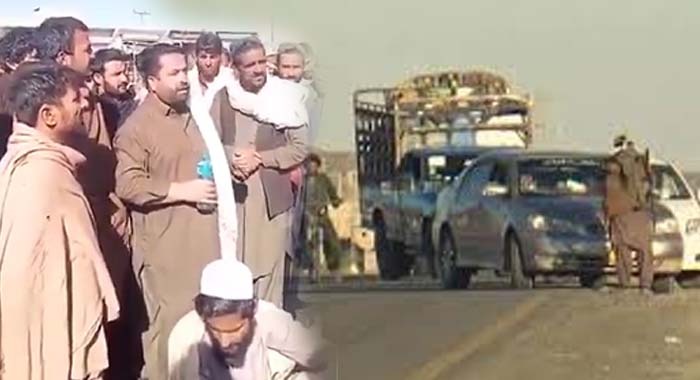
VIDEO OPENS: “What is this? What is happening today…?” One of the Balochistan’s citizens, holding a water bottle, among the crowd raises his voice.
“Why has it become ten feet long?” another man standing in the crowd asks.
“Today’s…” the man with the bottle manages to say only this when someone interrupts, annoyed:
“There are women here…!” He points to the presence of women in the crowd.
“Tah kho yo minute wadrayzha, just wait a minute…” the bottle‑holder tries to silence him with a hand gesture.
This is Balochistan’s main highway. Several voices rise at once. Because so many people are speaking together, it sounds like a constant hum of noise. One cannot clearly understand every word, but it is obvious that these are travelers. They have been stranded for three or four days in one spot. They are distressed. They are complaining, frustrated, and helpless.
“And because of your sit‑in, we have been stuck here with you. Last night our buses were looted. Thieves came, locals looted us…”
The crowd erupts again.
“Thieves looted us, extortionists at work…” another person shouts in agreement.
“You know this…” a third man says, confirming the others and insisting the protesters are fully aware.
“Yo minute kho wadrayzha yara…” the man with the bottle pleads again, trying to calm the crowd.
“Yar, be quiet…” another voice urges.
“Daer zor rakei yara…” another man expresses grief, anger and helplessness.
“The buses have been looted, fine, they have been looted. There are women here. There is no proper space for them, no place to sit. So through the media, I want to say this… I want to appeal to those staging this protest. For God’s sake, show mercy to these women sitting inside the buses, to those who are sick, to the children. At least give them a way out. At least open the road for one hour during the day. Even your little child comes and stands in front of the buses. What kind of humanity is this? Are these not Muslims, not human beings, who have been standing on this road with you for four days in this cold? What facilities are you giving us, what are you giving to these children, to these women? And on top of that, thieves come at night and loot the buses. Should we support your sit‑in or should we protect ourselves? You can neither give us safety nor give us passage. Either give us protection, or take us to your homes, or let us go. This is not how things work. Look at all these people, how distressed they are. A woman has died here. Was she not human? Was she not Muslim? Yesterday a man also died here in front of you. At least give us one hour so these women and children can leave. They are also your mothers and sisters. They are not outsiders.”
The video ends with the man’s appeals. What happened afterwards is unclear.
The likely assumption is that once the sit‑in dispersed, the stranded passengers finally found relief from the ordeal.
What can be said with certainty is that the Baloch public has grown exhausted with these self‑styled human rights champions and so‑called representatives of tribe, nation or community. The frustration comes from the very existence of these self‑appointed guardians, who manufacture one excuse after another to stage protest after protest. At BYC rallies, roads are blocked, women and children are used as shields, while in the background BLF, BLA and similar militant outfits loot and harass people.
At the same time, the people of Balochistan openly reject the activities of terrorist organisations like BLF and BLA, and facilitators hiding behind labels such as BYC. Those “thieves” the stranded passengers referred to, the protesters know very well who they are. They are no one else but the militants of these very banned groups, who target security personnel, government installations and innocent unarmed civilians, and also disguise themselves in various roles to rob, intimidate and manipulate ordinary Baloch.
But the Baloch public is no longer falling for their deception. Their resentment is clear. They see these groups as enemies of peace and development in Balochistan.



