
Following the return of several terrorist elements from Afghanistan, the security situation in Tirah Valley deteriorated as these individuals embedded themselves within civilian populations. Militants took refuge in mosques and civilian hujras, using them as hideouts and operational bases. Their presence among non-combatants significantly heightened the risk of collateral damage during counterterrorism operations, complicating efforts by security forces to neutralize the threat.
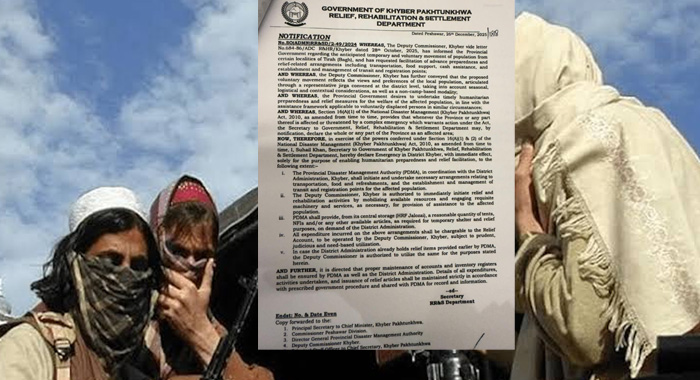
In response to the evolving security challenges, a series of local jirgas led by tribal elders were convened with the participation of the civil administration, the provincial government, and representatives of the security forces. These consultations thoroughly assessed the situation and explored multiple approaches to restore stability. After extensive deliberation, the local population, exhausted by prolonged fear and insecurity, collectively chose temporary relocation as the most viable and responsible option. This decision was formally endorsed under what became known as the Bagh Aman Jirga, reflecting a unified community commitment to enabling decisive action against terrorist elements.
Tirah Valley has an estimated population of approximately 90,000 people, comprising around 20,000 families. Historically, seasonal migration is a common practice in the area, with nearly half of the population moving to lower regions during the winter months while others remain behind to safeguard homes, livestock, and property. This year, however, the population reached an unprecedented consensus that all residents would relocate, thereby allowing security forces to conduct unrestricted and aggressive Intelligence-Based Operations aimed at dismantling terrorist networks without endangering civilian lives.
Following the Bagh Aman Jirga decision, the provincial government established a dedicated administrative team and developed a comprehensive relocation plan. A budget of Rs. 4 billion was approved from the provincial treasury to support the relocation process. Responsibility for registration, logistics, and civilian management was assigned exclusively to provincial and district administrations, with the Pakistan Army and security forces having no role in the registration or relocation of residents.
Once these arrangements were finalized, relocation commenced in line with routine winter migration patterns. As of now, approximately 65 percent of the population has already relocated, while the remaining families are in the process of moving to designated areas. However, heavy snowfall and visible administrative shortcomings created hardships for some displaced families. In response to the immediate humanitarian needs, Pakistan Army units stepped in to assist distressed civilians, consistent with the Army’s longstanding tradition of providing emergency relief during natural disasters and crises, as currently demonstrated in regions such as Kashmir, Murree, and Balochistan.
Rather than addressing these administrative gaps, Sohail Afridi and members of his cabinet have, for political expediency, sought to shift responsibility onto the military. Such efforts risk obscuring the clear division of responsibilities and divert attention from the need for effective civilian administration and accountability.
The relocation of Tirah Valley residents was a collective decision taken under the Bagh Aman Jirga, with full administrative and logistical responsibility resting with the provincial government. The establishment of camps, provision of facilities, compensation to displaced families, and post-operation rehabilitation including the restoration of homes, infrastructure, and road networks fall squarely within the provincial government’s mandate. The Pakistan Army and security forces remain focused solely on their core mission of combating terrorism and restoring lasting peace and security in the region.



