
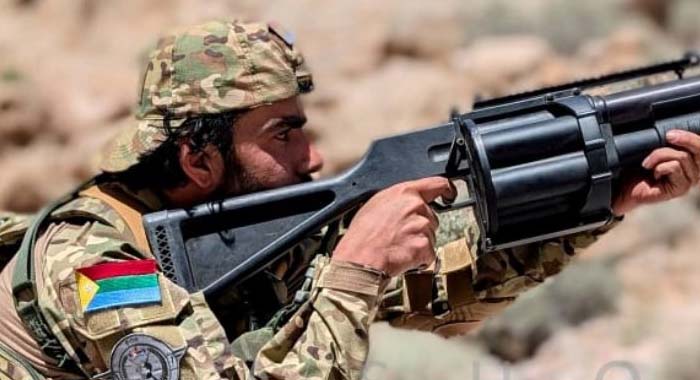
A long-standing claim surrounding the alleged enforced disappearance of Asif Baloch has been decisively undermined following the circulation of a video message from Afghanistan in which he appears openly as a commander of the Baloch Liberation Front (BLF), a banned militant organization. Reported missing since 2018 and repeatedly cited by the Baloch Yakjehti Committee (BYC) as a victim of state action, Asif Baloch’s re-emergence exposes serious contradictions in the narrative that was promoted for years at national and international forums.
In the video, Asif Baloch is seen operating freely from across the border, not as a detained or silenced individual, but as an active militant leader issuing threats, including warnings directed at members of the Baloch community itself. This public appearance fundamentally challenges the portrayal of him as a “missing person” and instead confirms his continued involvement in armed militancy while evading accountability under the cover of a fabricated victimhood narrative.
The revelation once again brings into question the credibility of claims advanced by certain pressure groups that have consistently accused Pakistani security institutions of enforced disappearances without verifiable evidence. The Asif Baloch case demonstrates how the “missing persons” discourse has, in some instances, been deliberately exploited to shield militants, generate sympathy, and malign state counterterrorism efforts, while those involved remain active participants in violence from foreign safe havens.
Equally troubling is the fact that the individual now exposed as a militant commander has directed threats toward ordinary Baloch citizens, laying bare the coercive nature of such groups. This directly contradicts the claim that militant organizations represent the interests or aspirations of the Baloch people, revealing instead a pattern of intimidation, fear, and propaganda used to sustain relevance and control.
This development underscores the urgent need for responsible reporting, critical scrutiny of allegations, and a clear distinction between genuine human rights concerns and narratives constructed to protect armed actors. The case of Asif Baloch stands as a clear reminder that misinformation, no matter how persistently repeated, cannot conceal the truth indefinitely, and that the misuse of human rights rhetoric ultimately harms legitimate causes while emboldening violence.



