
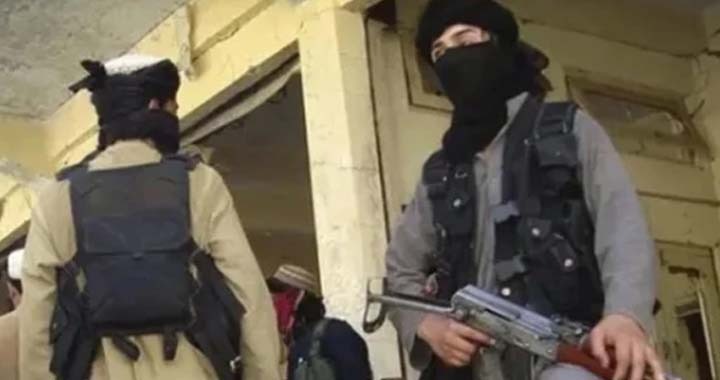
Director General Inter-Services Public Relations (DG ISPR) Lt Gen Ahmed Sharif Chaudhry, during an extensive security briefing with senior journalists on November 25, declared in unequivocal terms that the Afghan Taliban regime has become a threat not only to Pakistan but to the entire region and the wider world. He said Afghan soil is being used for terrorist infiltration into Pakistan, with full facilitation from the Taliban authorities.
The DG ISPR noted that concerns over Afghanistan are shared globally, including by peaceful nations such as Denmark. He referred to the recent attack on Chinese engineers in Tajikistan, which was also carried out from Afghan territory. China has demanded a thorough investigation. Although the Taliban regime expressed regret, it took no disciplinary action, raising questions about its control within Afghanistan.
He said the incident in Tajikistan reflects the alarming fact that Taliban rule remains weak and ineffective. He added that Pakistan has presented concrete evidence to the Taliban leadership showing that terrorist networks; including al-Qaeda, Daesh and other militant organisations, continue to operate from Afghan soil. These groups receive weapons and funding in Afghanistan, which are then used against Pakistan.
Lt Gen Chaudhry said Pakistan has asked the Taliban regime to agree to a verifiable mechanism, even if monitored by a third party. He emphasised that this demand is well known to international mediators, and in line with the commitments made by the Taliban in the Doha Agreement—commitments they have yet to fulfil.
Commenting on the Taliban claim that members of “Fitna al-Khawarij” are Pakistani nationals who migrated and are now “guests”, the DG ISPR rejected the argument as illogical. He said if they are Pakistani, they should be handed over for trial under Pakistani law. “How can armed militants attacking Pakistan be considered guests? Hospitality has principles; no guest takes refuge in one home and attacks another,” he remarked.
Citing a SIGAR report, he said the US military left behind equipment worth 7.2 billion dollars during its withdrawal, adding to Afghanistan’s destabilising potential. He warned that since 2021, Afghanistan has failed to establish a functional state or government and continues to harbour non-state actors who pose a grave threat to regional countries.
He further said the Taliban regime cannot claim to represent Afghanistan’s people, as it excludes major ethnic groups and half of the country’s population—its women. Pakistan, he said, has no quarrel with Afghans, but its concerns lie strictly with the Taliban authorities. He stressed that border trade disruptions are directly linked to Pakistan’s responsibility to protect its people, asserting, “Bloodshed and trade cannot go together.”
The DG ISPR said that Pakistan-Afghanistan trade largely revolves around smuggling, from which neither country benefits. Instead, terrorist groups and criminal networks profit, fuelling violence and bloodshed. Border regions, he said, have evolved into strong political-terror-crime nexuses facilitated by militant groups.
Responding to allegations about Pakistan’s border management, he noted that the Pak-Afghan frontier is one of the most difficult terrains in the world. The 1,229-kilometre-long border in KP alone has 20 crossing points, with military posts sometimes 20 to 25 kilometres apart. Border fencing is only effective when supported by observation and firepower, which require substantial resources.
Detailing Pakistan’s counterterrorism operations, the DG ISPR said that this year alone, security forces conducted 12,857 intelligence-based operations in KP and 53,309 in Balochistan. A total of 1,873 terrorists were killed, including 136 Afghan nationals—numbers that illustrate the scale of terrorist activity and the extent of Afghan involvement.
He questioned who is responsible for stopping illegal cross-border movement, smuggling and the influx of non-custom-paid vehicles inside Pakistan—vehicles that often end up being used in suicide attacks. He also warned about foreign-based social media accounts generating anti-Pakistan propaganda in real time.
Lt Gen Chaudhry said a coordinated system to implement the National Action Plan (NAP) exists in Balochistan—featuring steering, monitoring and implementation committees at provincial, divisional and district levels—but is lacking in KP. The government’s crackdown on Iranian diesel smuggling has reduced daily smuggling from 20.5 million litres to 2.7 million litres, cutting off a major source of terror financing.
He added that 86 percent of Balochistan—spread across 27 districts—has now been brought under police jurisdiction, and continuous community engagement is yielding long-term improvements. Such integrated efforts, he stressed, are essential for controlling terrorism.
The DG ISPR concluded that to eradicate terrorism, federal and provincial governments must operate under a unified and comprehensive mechanism, coupled with seamless coordination among all intelligence and security agencies. With a fully cohesive approach, he said, defeating terrorism is entirely achievable.



