
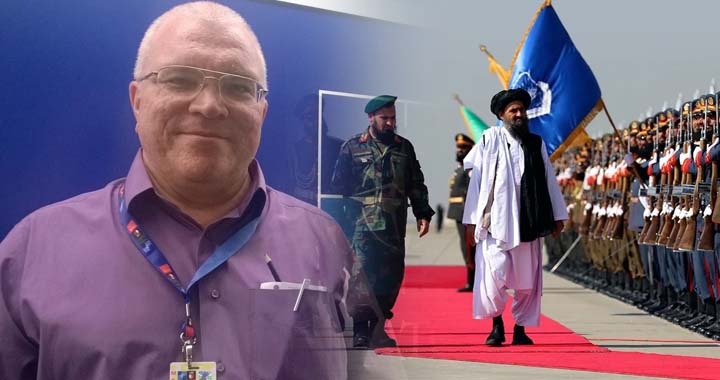
A newly released book by a prominent Russian analyst claims to reveal sensitive internal intelligence documents linked to the Taliban, shedding light on alleged secret foreign contacts, leadership security anxieties, and emerging regional militant threats that could have far-reaching implications for Afghanistan and beyond.
The book, titled Taliban Intelligence Secrets, is authored by Andrey Serenko, head of the Russian Centre for Contemporary Afghanistan Studies. Serenko asserts that the publication is based on confidential Taliban intelligence materials that outline the group’s internal security architecture, covert diplomatic engagements, and evolving threat perceptions. The authenticity of the documents cited in the book has not been independently verified.
One of the most striking claims in the book is that the Taliban leadership is exploring the creation of an “Iron Dome”-style air defence system, potentially positioned over Kandahar or directly above the residence of Taliban supreme leader Hibatullah Akhundzada.
According to Serenko, internal Taliban discussions reflect heightened concern over potential air threats, driven by repeated sightings of unidentified drones over Kandahar, where Akhundzada is believed to reside. The book claims that protecting the Taliban leader from possible aerial attacks has become a top security priority.
Serenko further writes that Taliban officials have emphasized the need to train specialists in China to operate advanced air defence systems, citing Beijing’s military-technical expertise and what he describes as a high level of mutual trust between the Taliban authorities and the Chinese government. He adds that Akhundzada’s inner circle intensified security planning during the summer, with a specific focus on countering aerial surveillance and strike capabilities.
The book also alleges that Taliban intelligence maintains secret contacts with the U.S. Central Intelligence Agency (CIA). Serenko claims that Taliban intelligence officials have held undisclosed meetings with U.S. intelligence representatives in Saudi Arabia and Qatar.
According to documents cited in the book, the CIA is allegedly kept informed of the outcomes of Taliban intelligence visits to Moscow. Serenko claims that two Taliban intelligence officials met with U.S. intelligence representatives before traveling to Russia, suggesting a covert channel of communication between Washington and Kabul.
The author further alleges that U.S. intelligence activity inside Taliban structures has increased since Donald Trump’s return to power, with the CIA seeking insights into Russian influence and activities in Afghanistan through Taliban intermediaries.
In another controversial claim, Serenko writes that the Taliban invited U.S. officials to visit Bagram Air Base, allegedly aiming to influence President Trump’s stance on the future of the strategic installation.
Trump has repeatedly stated that the Taliban should return Bagram Air Base to U.S. control. Serenko characterizes the alleged Taliban initiative as a “new intrigue” reflecting the group’s efforts to maneuver diplomatically amid shifting geopolitical dynamics.
Beyond leadership security and foreign intelligence ties, the book raises alarm over the broader militant landscape inside Afghanistan. Serenko claims that the country hosts numerous small, autonomous jihadist groups actively seeking financial sponsors to carry out attacks in Central Asia.
He further alleges that following the collapse of Bashar al-Assad’s regime in Syria, a growing number of foreign fighters have left the region and are increasingly relocating to Taliban-controlled Afghanistan. According to his sources, al-Qaida and other jihadist organizations are attempting to regroup and rebuild operational capacity within the country.
In an interview with Afghanistan International, Serenko warned regional and international actors against placing trust in the Taliban, describing the group as an unpredictable and opaque structure that poses risks to Afghanistan, regional stability, and global security.
Serenko stated that the documents were supplied by what he described as “patriotic Afghans” and claimed that individuals in Russia, including some allegedly linked to the presidential office, have reviewed the materials. He added that portions of the information had previously been published in the Russian newspaper Nezavisimaya Gazeta.



